The $70 Billion Immigration Enforcement Bill Just Passed the Senate — Here’s What You Need to Know
The immigration enforcement bill that Washington has been fighting over for weeks finally cleared the Senate early this morning — and I’ll be honest, I was half-asleep scrolling my phone at 5 a.m. when the alert hit. My first reaction was: this is a massive deal, and a lot of people have no idea what’s actually in it. So let me break it all down for you.
Senators voted 52–47 in favor of the $70 billion bill to fund Immigration and Customs Enforcement and Border Patrol for the next three years, through the end of Trump’s term. That’s not a small thing. That’s a generational investment in federal immigration agencies, passed while most of the country was asleep.
So what does this immigration enforcement bill actually mean for you, for the country, and for the ongoing debate over border security? Let me walk you through it.
What’s Inside the Immigration Enforcement Bill: The Real Numbers
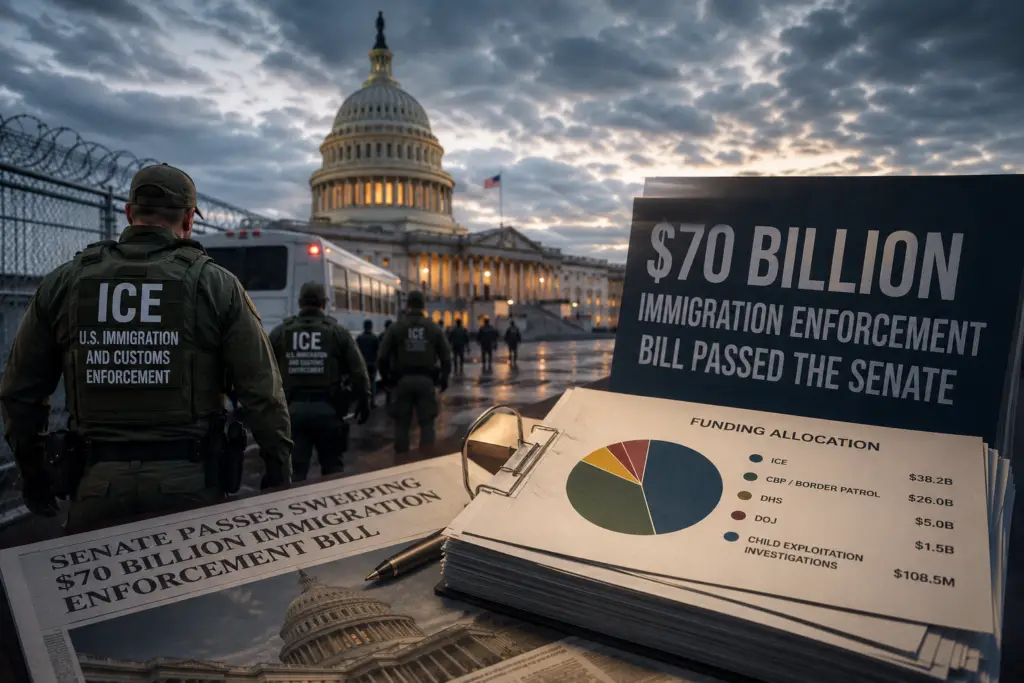
The immigration enforcement bill is, first and foremost, a funding package — and the dollar amounts are staggering. The proposal allocates about $72 billion overall, with most of the funding directed toward enforcement. Let that sink in for a second. Seventy-two billion dollars.
The largest share, $38.2 billion, is designated for ICE to expand and sustain its operations, including hiring personnel, supporting detention and removal efforts, upgrading technology and facilities, and increasing cooperation agreements with local law enforcement. That’s where the bulk of this immigration enforcement bill’s money goes — directly to ICE.
The rest of the funding breaks down like this:
- Customs and Border Protection (CBP), which oversees U.S. Border Patrol, will receive about $26 billion to hire and equip personnel, enhance surveillance and inspection systems, and carry out border screenings.
- The Department of Homeland Security (DHS) is allocated roughly $5 billion for broader operational and enforcement-related purposes, while the Department of Justice (DOJ) will receive about $1.5 billion to support immigration-related legal enforcement and administration.
- The bill also includes $108.5 million for child exploitation investigations.
From where I sit, this immigration enforcement bill is essentially a three-year budget for Trump’s mass deportation agenda. The legislation provides tens of billions of dollars in new funding aimed primarily at expanding federal immigration enforcement operations, structured to support hiring, equipment, and operational costs across multiple agencies.
The package represents one of the largest investments in immigration enforcement in recent years. And yet, almost nobody is talking about the procedural maneuver that made it possible.
How the Immigration Enforcement Bill Got Around the Filibuster
Senate Republicans advanced the measure through the budget reconciliation process, allowing it to pass with a simple majority vote. That means they needed 51 votes instead of the usual 60. Without reconciliation, this immigration enforcement bill almost certainly would have died.
Sen. Lisa Murkowski criticized the use of the budget reconciliation process, which allows senators to advance legislation related to taxes and spending with a simple majority vote rather than the usual 60-vote threshold needed to overcome legislative filibusters. And she’s the only Republican who voted against the final package. That says something.
So you’ve got a situation where the immigration enforcement bill passed on a strict party-line vote — almost. Sen. Lisa Murkowski, R-Alaska, was the only Republican to vote against the final package, which was also opposed by all Democrats. Every other Republican fell in line, even those who had deep reservations.
The Controversy Buried Inside This Immigration Enforcement Bill
Here’s the thing nobody’s really talking about enough. The immigration enforcement bill nearly collapsed — not over immigration, but over an unrelated fund. Fierce bipartisan backlash over a $1.8 billion “anti-weaponization” fund threatened to derail the bill entirely. That’s the part of this story that I find genuinely alarming.
The Senate voted 52-47 to approve the legislation with no provision to ban the $1.8 billion “anti-weaponization” fund that could compensate Trump’s political allies for allegations that the government mistreated them. Democrats and even some Republicans wanted that fund gone. It didn’t happen.
And the fallout wasn’t pretty. Schumer’s measure to kill the fund failed in a 50-49 vote but exposed the political turmoil among rank-and-file Senate Republicans, some of whom sought their own amendments to eliminate the fund permanently, five months before the November midterm elections.
That’s a window into how messy this whole process was. The immigration enforcement bill became the vehicle for a much larger political fight. Whether you support stricter border security or not, the way this legislation moved through the Senate should raise your eyebrows.
Democrats also pushed back on what they saw as a lack of safeguards. Democrats say any funding bill for the Homeland Security Department should place restraints on federal immigration authorities, including better identification for federal officers and more use of judicial warrants. None of those proposals made it into the final text of the immigration enforcement bill.
What Happens Next With the Immigration Enforcement Bill — and What You Should Watch
The immigration enforcement bill now moves to the House. The House is not expected to take up the measure before next week. But once it does, the real fight may just be beginning. The House has its own priorities, its own factions, and its own timeline.
If you care about immigration policy — from either direction — here’s what you should be paying attention to right now:
- Watch for House amendments. The House could add or strip provisions before sending it to Trump’s desk, which means the immigration enforcement bill you’re reading about today may look different by the time it becomes law.
- Track the “anti-weaponization” fund fight. That $1.8 billion settlement pot is still unresolved. Courts are already involved. Republican Senator Bill Cassidy joined Democratic Senator Cory Booker in a friend-of-the-court brief urging a federal judge to maintain the block on Trump’s fund.
- Monitor ICE hiring. If you want to know how this immigration enforcement bill is actually being implemented, watch ICE’s staffing numbers over the next 12 months. That’s where the rubber meets the road.
- Keep an eye on detention capacity. The legislation is designed to expand detention capacity, increase staffing for border agencies, and provide resources for ongoing deportation operations. Those expansions will have real, visible effects in communities across the country.
I’d also say — and this is my honest take — that the speed of this vote matters. The final vote came shortly before 5 a.m., following an 18-hour “vote-a-rama” during which senators could offer amendments. Passing a $70 billion immigration enforcement bill at five in the morning after an 18-hour marathon session isn’t exactly transparent governance. Make of that what you will.
Senate Republicans used a complicated procedural maneuver to get around the filibuster and pass the budget legislation with no Democratic votes. That sets a precedent for how major spending bills can be pushed through, and it’s worth understanding even if immigration isn’t your primary issue.
Final Word
The immigration enforcement bill that just cleared the Senate is, by any measure, a landmark piece of legislation. Whether you think it’s a necessary investment in national security or an overreach that bypasses democratic norms, you need to be paying attention to what happens next.
My take? The dollar amounts are historic. The process was chaotic. And the unresolved “anti-weaponization” fund controversy means this story isn’t over — not even close. The immigration enforcement bill will face more scrutiny in the House, in the courts, and in the court of public opinion.
Keep watching the news. Talk to your representatives if you have strong feelings either way. And remember that $70 billion is your tax money — you have every right to understand exactly how this immigration enforcement bill plans to spend it.