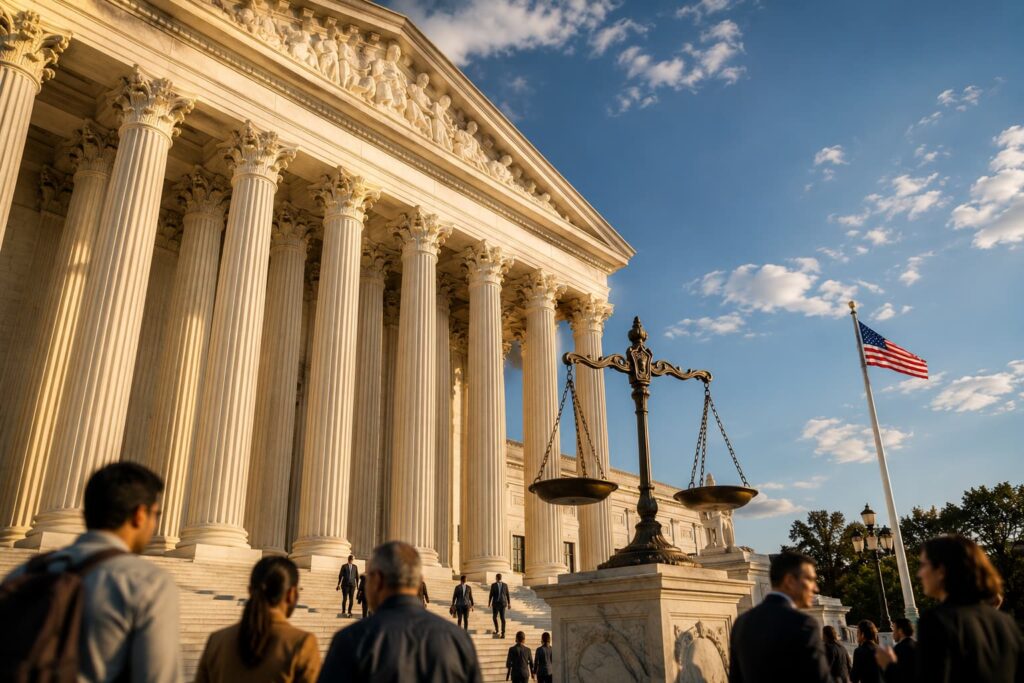
Supreme Court Immigration Rulings Are Reshaping American Law in Real Time
The Supreme Court immigration rulings defining the 2025–2026 term will have far-reaching implications for millions of Americans. I’ve been mapping these cases against the structural patterns of prior shifts in immigration law — and what I’m watching right now isn’t a series of isolated decisions. It’s a systematic redrawing of who has legal standing, who has legal status, and critically, who has access to judicial review at all. The question you should be asking isn’t just “what did the court decide?” It’s “what does this remove from the picture going forward?”
What the June 2026 Supreme Court Immigration Rulings Actually Changed
On June 25, 2026, the Supreme Court issued two seismic immigration law decisions, ruling 6-3 in the Trump administration’s favor in each case. The first, Mullin v. Doe, overturns lower court decisions blocking the administration’s move to end Temporary Protected Status (TPS) for roughly 350,000 Haitians and 4,000 Syrians. The second, Mullin v. Al Otro Lado, endorses a policy permitting border officials to turn away asylum seekers arriving by land at ports of entry.
Justice Samuel Alito wrote both opinions. What most coverage has underweighted is the structural mechanism at the core of the TPS ruling — it isn’t simply that TPS was revoked. The Supreme Court ruled 6-3 that a provision of the TPS statute prevented courts from hearing any lawsuits challenging the DHS secretary’s failure to follow required legal procedures. That’s a profound shift. The court didn’t just hand the administration a win on the merits — it effectively removed the judicial check on future TPS decisions altogether.
The decision could have consequences for more than 1 million immigrants from 17 countries that received TPS because of wars, natural disasters, or other extraordinary conditions. The Trump administration has already moved to rescind protections for immigrants from 13 of those countries. From the structural pattern I’ve been tracking, this ruling operates less like a verdict on Haiti and Syria specifically, and more like a template — one that the administration can now apply across the board with minimal judicial interference.
On the asylum metering question, the court cleared the way for the Trump administration to revive a policy that aims to curb the number of migrants that officials at the southern border must process to determine whether they have a right to seek asylum in the US. The Department of Homeland Security’s general counsel, James Percival, called it “an important tool to continue securing our southern border,” and the administration argued the metering policy has been used by presidents of both parties. But here’s the legal detail that matters: U.S. law allows people seeking refuge to apply for asylum once they are on American soil, regardless of whether they came legally. To qualify, they must show a fear of persecution for specific reasons like race, religion, nationality, membership in a particular social group, or political opinion. The metering decision narrows access to that process before it can even begin.
The Birthright Citizenship Case — What Comes Next and Why It’s Different
The case I’d argue you should be watching even more closely is still pending. The court must still rule on the president’s attempt, via an executive order, to end birthright citizenship as it has been understood in the United States for more than a century. This one is analytically distinct from the TPS and metering decisions — and the distinction matters enormously.
The United States is one of a few dozen countries that guarantees citizenship to any individual born within its territory — a policy in place since Congress ratified the Fourteenth Amendment in 1868. But efforts to end the practice have increased as critics say it encourages unauthorized migration. If implemented, the executive order would deny automatic birthright citizenship to children born to undocumented immigrants and temporary visa holders, potentially affecting hundreds of thousands of children born annually on U.S. soil. The order triggered multiple legal challenges and led several district courts to issue nationwide injunctions blocking its implementation.
Where most people get this case wrong is assuming it’s a simple constitutional showdown. The more nuanced read — and the one that SCOTUSblog’s April 2026 analysis supports — is that the court may actually dodge the constitutional question entirely. Justice Kavanaugh asked why the court needed to decide whether the executive order violates the citizenship clause if it could resolve the case based only on the Immigration and Nationality Act, citing the court’s general presumption to avoid deciding constitutional questions if possible. That’s a very telling signal. A narrow statutory ruling would hand challengers a win without touching the 14th Amendment — preserving the constitutional question for a future, perhaps more favorable, court.
In a nationwide poll conducted in April 2026 by Reuters and Ipsos, 64 percent of respondents opposed ending birthright citizenship, compared to 32 percent who supported it. And the Council on Foreign Relations notes that repealing birthright citizenship would actually require a constitutional amendment — needing two-thirds approval in both chambers of Congress and ratification by at least 38 states. That’s not a path the current administration can walk unilaterally, which makes the executive order strategy the only viable lever — and a legally fraught one at that.
What These Decisions Mean If You’re Navigating the System Right Now
The structural reality — and this is what most commentary skips — is that these decisions don’t just affect the people directly named in the cases. They reset the procedural landscape for anyone in the immigration system. The court said that questions of whether the DHS secretary followed the law cannot be heard by courts in the first place — meaning that in the future, even an openly unlawful decision to grant or terminate TPS could be entirely insulated from judicial review. That’s a significant narrowing of the safety net.
For TPS holders from countries beyond Haiti and Syria, the implications are immediate. Nearly 300,000 people still retain TPS that has yet to expire or be terminated — including almost 200,000 Salvadorans who have had TPS for over 25 years and 50,000 Ukrainians who have had TPS since the outbreak of the war. They are all now at further risk. Unless Congress takes steps to provide permanent legal status to TPS holders, hundreds of thousands are now vulnerable to losing work authorization and facing deportation.
For anyone with a pending asylum claim, recent decisions have expanded judges’ ability to deny cases when applicants fail to provide sufficient evidence. And for families with U.S.-born children whose parents lack legal status, a ruling limiting birthright citizenship could raise difficult legal questions and could even leave some U.S.-born children stateless — without citizenship and without the protections of an American citizen. Legal experts typically advise that anyone in these categories should consult an immigration attorney immediately to understand how the evolving case law specifically applies to their situation — not wait for outcomes to fully settle.
The American Immigration Council has published a detailed analysis of both the TPS and metering decisions, worth reading in full. For the primary court documents, the Supreme Court’s official slip opinions are publicly available and worth consulting directly if you’re navigating a legal matter connected to these rulings.
Final Word
The pattern I keep seeing across these cases is a consistent structural theme: the executive branch is expanding its discretionary authority over immigration precisely by narrowing the mechanisms through which courts can review its decisions. That’s the analytical thread connecting the TPS ruling, the metering decision, and the still-pending birthright case. Supreme Court immigration rulings in this term aren’t just about individual outcomes — they’re collectively redefining how much of immigration law sits beyond judicial reach.
If you have TPS, a pending asylum case, or a family member whose status is tied to any of these decisions, the honest guidance from legal experts is this: don’t wait for the dust to settle before getting a case assessment. Supreme Court decisions are final, but changes can still come from Congress or the executive branch. The political and legal landscape around these decisions is genuinely in motion, and the next term may shift the picture again. Stay informed, document your status carefully, and consult qualified legal counsel — because in 2026, the Supreme Court’s immigration decisions are anything but static.
This article reflects publicly available legal information for educational purposes only. Consult a qualified attorney for advice specific to your situation.
Frequently Asked Questions About Supreme Court Immigration Rulings
What are Supreme Court immigration rulings and why do they matter?
Supreme Court immigration rulings are binding legal decisions issued by the U.S. Supreme Court that interpret federal immigration law, define the limits of executive power, and determine the rights of noncitizens within the United States. These rulings set national precedent, meaning lower courts and federal agencies must follow them when handling immigration cases. Because they can reshape enforcement priorities, visa policies, and deportation procedures overnight, they have a direct and lasting impact on millions of immigrants and their families. If you believe a ruling affects your immigration status, consulting a licensed immigration attorney is the best way to understand your specific situation.
What risks should immigrants be aware of when a new Supreme Court ruling is announced?
When the Supreme Court issues a major immigration decision, enforcement practices can shift quickly, sometimes expanding the government’s authority to detain or remove individuals who previously had procedural protections. Immigrants in pending cases may find that the legal landscape changes before their matter is resolved, potentially affecting their eligibility for relief. Supreme Court immigration rulings can also alter how asylum claims, visa applications, or DACA-related protections are processed at the administrative level. Because individual circumstances vary significantly, anyone with an open immigration case should speak with a qualified immigration lawyer before concluding how a new ruling applies to them.
How can I stay informed and understand how a Supreme Court immigration ruling affects me?
The most reliable way to track new decisions is to follow official sources such as the Supreme Court’s website (supremecourt.gov), the Department of Homeland Security, and U.S. Citizenship and Immigration Services, which publish guidance after significant rulings. Reputable legal news outlets and nonprofit immigration organizations also provide plain-language summaries that break down complex decisions for general audiences. Reading a court’s official syllabus — the brief summary attached to each opinion — is a good starting point for understanding the core holding without needing a law degree. For guidance on how any ruling specifically applies to your case or status, a licensed immigration attorney or accredited representative is your most dependable resource.
How do 2026 Supreme Court immigration rulings compare to landmark past decisions?
Historically, landmark rulings like Arizona v. United States (2012) and Department of Homeland Security v. Regents of the University of California (2020) set major boundaries around state enforcement powers and executive discretion, respectively. The 2026 term has continued that pattern, with the Court revisiting questions about due process rights during removal proceedings and the scope of presidential authority over immigration enforcement. While earlier decisions often centered on defining which level of government held primary power, more recent Supreme Court immigration rulings have increasingly focused on procedural rights and judicial review — questions about when and how immigrants can challenge government action in court. Legal analysts note that each new term builds on, refines, or occasionally narrows prior precedent, making it important to read current decisions in their full historical context.
Is it true that a Supreme Court ruling immediately changes immigration law across the whole country?
This is a common misconception — a Supreme Court ruling does not rewrite immigration statutes, but it does authoritatively interpret what existing law means, and that interpretation immediately becomes binding on all federal courts and agencies nationwide. In practice, it can take weeks or months for federal agencies like USCIS or ICE to update their internal guidance, training, and procedures to fully reflect a new decision. Additionally, some rulings are narrow and apply only to specific procedural contexts, so their practical effect may be more limited than initial news coverage suggests. Anyone trying to assess how a particular ruling changes their options should rely on updated agency guidance and advice from a licensed immigration professional rather than news headlines alone.