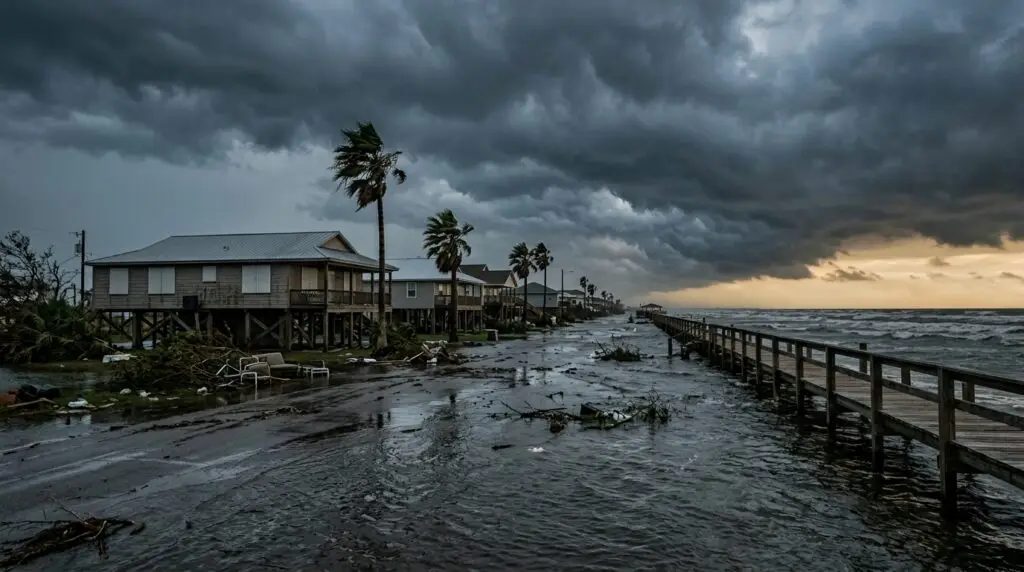
Gulf Coast Flood Insurance Is on Every Homeowner’s Mind as Tropical Storm Arthur Hits
Gulf Coast flood insurance is something I’ve watched people scramble for at the worst possible moment — right as a storm is already forming. This week, that moment is now. Tropical Storm Arthur, the first named storm of the 2026 Atlantic hurricane season, formed just off the coast of Texas on Wednesday morning, and it has turned into exactly the kind of slow-moving, rain-heavy threat that exposes how dangerously underinsured many coastal homeowners are. If you live anywhere from Texas to the Florida Panhandle, this is the article you need to read today.
What Tropical Storm Arthur Is Actually Doing to the Gulf Coast Right Now
A disorganized cluster of storms that had been plaguing the Gulf Coast for days came together to form Tropical Storm Arthur, and flash flooding is the main threat from this system. That’s the kind of sentence that sounds almost boring until water is coming under your front door. I’ve talked to enough homeowners after storm events to know that “flash flood threat” translates to real, devastating loss in a matter of hours.
The National Hurricane Center warned that “life-threatening flooding” was expected to continue in the southeastern U.S., with around 5 to 10 inches of rain falling in parts of Texas, Mississippi, and Louisiana, and as much as 20 inches in some isolated areas. Twenty inches. That’s not a rainstorm. That’s a catastrophe for anyone without Gulf Coast flood insurance.
Between 2 and 4 feet of storm surge is possible from Port Bolivar, Texas, to Morgan City, Louisiana. And the combination of storm surge and tide will cause normally dry areas near the coast to be flooded by rising waters moving inland from the shoreline. So even if you don’t think of yourself as a “flood zone” homeowner, Arthur doesn’t care about your FEMA map designation.
The highest flash flood potential over the next three days stretches from Lake Charles, Louisiana, to Montgomery, Alabama, with the highest rainfall totals expected near Mobile, Alabama, according to the National Hurricane Center. Flooding is likely through Friday over parts of Texas, Louisiana, Mississippi, Alabama, Georgia, and the Florida Panhandle. That is a massive geographic footprint — and Gulf Coast flood insurance gaps across that entire region are staggering.
The storms that fueled Arthur have been drenching the Gulf Coast for days, inundating vehicles and forcing a number of water rescues. At least two people have died, including a woman whose car was washed away outside San Antonio. This is not a drill.
The Gulf Coast Flood Insurance Gap Nobody Talks About Until It’s Too Late
Gulf Coast flood insurance sits at the center of a financial crisis that’s been building for years. Here’s the brutal truth most people find out after the water recedes: flood damage is not covered by homeowners’ insurance — homeowners and renters must buy a separate flood insurance policy, usually from the NFIP. And yet, far too many people still don’t have one.
The NFIP reports that one-third of NFIP claims originated outside high-risk flood areas between 2013 and 2023. And since 1998, nearly all U.S. counties — 99% — have experienced a flood. Read that again. Ninety-nine percent. The idea that flooding is “someone else’s problem” is genuinely one of the most expensive myths in American homeownership.
Floods are the most common natural disaster in the U.S. and the most costly. Just 1 inch of water can cause around $25,000 in damage to a home. Arthur could dump twenty times that amount in localized areas. Think about what that means for your personal finances if you’re not covered.
The Hidden Danger of Being Underinsured for Gulf Coast Flood Coverage
Gulf Coast flood insurance through the federal program has real coverage limits that many policyholders don’t fully understand until it’s too late. NFIP caps building coverage at $250,000 and contents at $100,000 for homeowners, with basement contents excluded entirely. If your home’s replacement cost exceeds $250,000, NFIP leaves you significantly underinsured.
That gap between what the NFIP pays and what your home actually costs to rebuild? It’s brutal. When Hurricane Ian devastated Florida in 2022, the average flood insurance claim payout was $69,000 — but many homeowners suffered damages exceeding $500,000. For NFIP policyholders, whose building coverage is capped at $250,000, this meant hundreds of thousands in out-of-pocket costs.
Homeowners in Gulf Coast states are facing a tightening home insurance market marked by soaring premiums, rising foreclosures, and growing coverage gaps. The data points to a worsening crisis in Louisiana, Florida, Texas, and Georgia. A report from the Consumer Federation of America shows significant premium increases between 2021 and 2024: 34% in Louisiana, 29% in Florida, 24% in Texas, and 20% in Georgia. And those are just the base homeowners’ premiums — separate from flood coverage entirely.
The situation gets darker when you look at what happened after Hurricanes Helene and Milton in 2024. After those storms pounded Florida’s Gulf Coast, FEMA was forced to borrow $2 billion to pay National Flood Insurance Program claims. The two hurricanes had led to more than 78,000 claims, with estimated losses possibly topping $10 billion. That’s the system Arthur is now putting additional pressure on, right at the start of a new season. You can check the current status of the NFIP and your coverage options directly through FEMA’s official flood insurance page.
Smart Steps to Take Right Now About Gulf Coast Flood Insurance
Gulf Coast flood insurance is one of those things where timing is everything — and not in a good way. There is typically a 30-day waiting period for an NFIP policy to go into effect, unless the coverage is mandated or is purchased as required by a government-backed lender. So if you’re uninsured today, Arthur has already made it too late to get covered before this storm passes. But there’s still plenty you can do right now and immediately after.
Here are the steps I’d take if I were sitting in a Gulf Coast home this week:
- Document everything in your home with photos and video before any floodwater arrives — this speeds up your claims process dramatically if you already have Gulf Coast flood insurance.
- Check whether your current policy covers contents as well as the building structure — many people carry one without the other and are shocked by the gap.
- Use FloodSmart.gov to check your flood zone and obtain an initial rate estimate, then cross-reference with FloodFactor, which assigns a risk score from 1 to 10 based on flood frequency and severity specific to your property.
- If your home’s value exceeds $250,000, start shopping private flood insurance options — private policies commonly offer $1,000,000 building limits and $500,000 contents coverage, plus basement protection.
- Contact your agent the moment the storm passes to begin the claims process — according to FEMA’s flood insurance guidance, you should call your agent directly, not FEMA.
One thing I genuinely recommend is looking into FEMA’s Community Rating System. Dozens of Gulf Coast communities participate in NOAA’s program that helps them qualify for the Federal Emergency Management Agency’s Community Rating System. Participating communities are eligible for discounted flood insurance rates when they complete actions to prevent or reduce flood losses. Your city might already qualify for discounts you’re not using. Read more about how NOAA is helping Gulf Coast towns lower flood insurance rates.
What to Watch Out For: Critical Gulf Coast Flood Insurance Mistakes
Gulf Coast flood insurance mistakes tend to fall into a few painful, predictable categories. Knowing them might save you tens of thousands of dollars. From what I’ve seen, the biggest errors people make are:
- Assuming homeowners’ insurance covers flooding. It doesn’t. Full stop.
- Waiting until a storm forms to buy a policy. That 30-day waiting period makes panic-buying useless.
- Relying only on NFIP limits when your home is worth more. Many NFIP policyholders are underinsured, creating major financial risk.
- Trusting that a “low-risk” flood zone means no risk. As we noted above, one-third of all NFIP claims come from outside high-risk zones.
And honestly? The most overlooked mistake I see is people dropping their policies because premiums are rising. Thousands of Americans have dropped their flood insurance coverage due to rapidly rising premiums. In recent years, more than 45,000 Texas policyholders and 21,000 Louisiana policyholders dropped their NFIP coverage. That’s a lot of people currently watching Arthur’s radar track with no protection in place. According to research tracked by the Insurance Information Institute, only 22% of homeowners even report being at flood risk, which tells you something about how dramatically the public underestimates this exposure.
In 2024, 41.9% of homeowner claims nationwide were closed with no payment, a steep increase from 25.8% in 2004. In many cases, properties remain uninsured for flood damage, as standard homeowners’ policies exclude such coverage. So not only are too many people uninsured, but those who do have standard homeowners policies are increasingly getting denied when they file claims. Gulf Coast flood insurance exists specifically to close that gap, and skipping it is a gamble that rarely pays off. For a deeper analysis of the NFIP’s financial challenges and future, the Environmental and Energy Study Institute has an excellent breakdown of proposed reforms.
Final Word
Tropical Storm Arthur is a wake-up call — one that the Gulf Coast gets handed almost every year, and one that too many homeowners keep hitting snooze on. Gulf Coast flood insurance isn’t a luxury or a technicality for people in mapped flood zones. It’s a financial survival tool for anyone living in a region where a named storm can dump a foot of rain before breakfast.
Here’s what I want you to take away from all of this. First, check your current coverage today — not when the next storm forms, today. Second, if your home is worth more than $250,000, talk to your agent about whether private flood insurance fills the gaps your NFIP policy leaves behind. Third, if you’re uninsured right now, put a reminder in your phone to get a quote the moment Arthur passes, and the 30-day clock becomes meaningful again.
The storms are coming — that part is certain. What isn’t certain is whether you’ll recover financially when one of them hits your neighborhood. The single smartest thing you can do for your home and your family’s financial future is to make sure you have proper Gulf Coast flood insurance before the next system forms.