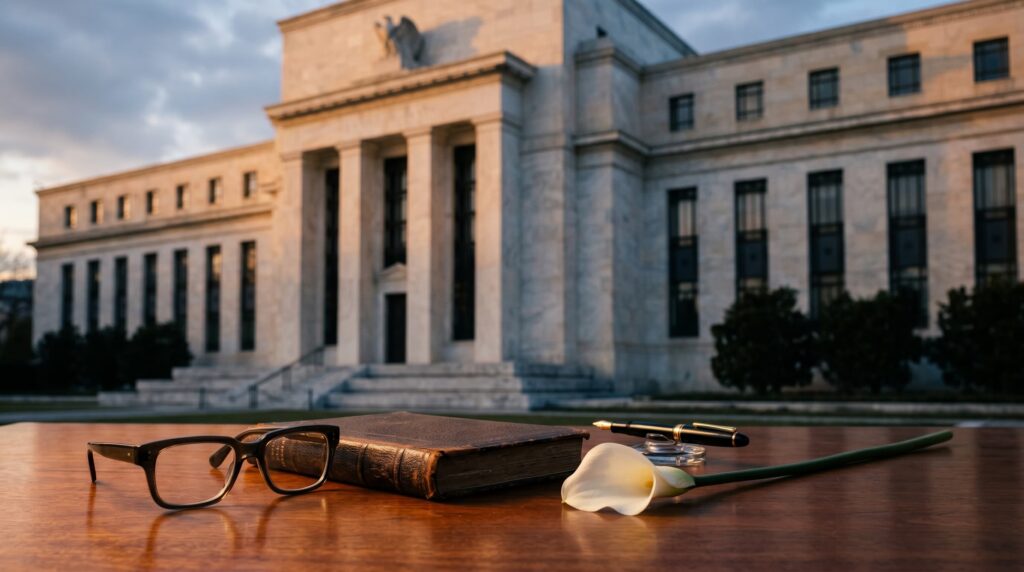
Tracking central bank policy for years teaches you to look past immediate market noise, but the passing of Alan Greenspan on June 22, 2026, marks the definitive end of an economic era. Seeing the news Monday morning causes any long-term market observer to pause. Alan Greenspan, the former Federal Reserve chairman famously dubbed "The Maestro," has died at the age of 100. Few figures in modern financial history have wielded as much quiet power over the global economy, and understanding his legacy offers essential lessons for our financial future.
This isn’t just an obituary for an influential economist. It is a look at the architect of modern American capitalism—a man whose policy choices still influence your mortgage rates, your retirement accounts, and the stability of the global banking system today.
The Century of the Maestro: The Core Facts
Alan Greenspan (March 6, 1926 – June 22, 2026) achieved a rare milestone, living a full century and witnessing the profound evolution of modern capitalism. According to a statement from his family, he passed away peacefully at his home due to complications from Parkinson’s Disease.
For nearly two decades, he was the primary steward of the U.S. economy:
- Unprecedented Tenure: Appointed by Ronald Reagan in 1987, Greenspan served five terms under four different presidents, concluding his service under George W. Bush in 2006. His 18.5-year run is the second-longest in Federal Reserve history.
- The Great Moderation: His leadership coincided with a prolonged period of economic stability characterized by low inflation, robust job growth, and massive stock market gains from the mid-1980s until the mid-2000s.
- A Cultural Icon: Despite his dry, academic speaking style, Greenspan achieved an almost celebrity-like status, with the media frequently treating his ambiguous public statements as financial prophecy.
Maestro or Cautionary Tale? A Complicated Legacy
It is tempting to categorize economic leaders as either heroes or villains, but macroeconomic history is rarely that simple. Greenspan’s legacy is defined by both the historic economic booms he nurtured and the systemic vulnerabilities he left behind. He was a masterful crisis manager, but a deeply reluctant regulator.
To understand his impact, we have to look at how his Fed responded to the defining economic shocks of his era:
| Historical Event | Greenspan’s Action | Long-Term Outcome |
|---|---|---|
| 1987 Black Monday Crash | Flooded the banking system with immediate liquidity. | Prevented a broader financial panic; established the baseline for modern Fed interventions. |
| The 1990s Tech Boom | Managed a delicate “soft landing” in 1994 by preemptively tweaking interest rates. | Sustained a 107-month economic expansion, the longest official growth streak in U.S. history at the time. |
| Early 2000s Dot-Com Bust & 9/11 | Lowered benchmark interest rates down to a historic low of 1%. | Cushioned the short-term shock but inadvertently laid the groundwork for the subprime housing bubble. |
The core criticism of Greenspan’s philosophy centers on his fierce advocacy for financial deregulation. He operating under the firm belief that major financial institutions could effectively police themselves. While his low-interest-rate environment kept the economy humming through the late 1990s, it also allowed hidden risks to accumulate across Wall Street, eventually culminating in the 2008 global financial crisis shortly after his retirement.
A Rare Admission of Error: Unlike many figures in public life, Greenspan explicitly acknowledged the flaws in his worldview. In a famous 2008 congressional testimony, he admitted: “I made a mistake in presuming that the self-interests of organizations, specifically banks and others, were such that they were best capable of protecting their own shareholders and their equity in the firms.”
4 Essential Lessons for Today’s Investors
Greenspan’s historical journey offers deeply practical takeaways for anyone managing a personal portfolio or trying to make sense of today’s economic climate.
- Interest Rates Anchor Everything: The cost of borrowing money determines the value of all asset classes. Greenspan’s career proved that keeping rates too low for too long creates asset bubbles, while raising them too quickly can choke off economic growth.
- Markets Require Referees: Financial self-regulation has structural limits. Without clear oversight and transparent boundaries, systemic risk naturally concentrates in the dark corners of the financial system.
- Short-Term Success Can Obscure Long-Term Risk: A policy that looks brilliant today might take a decade to reveal its unintended side effects. True economic health must be measured across entire market cycles, not just consecutive quarters of growth.
- Humility is Mandatory: The ultimate lesson of the Greenspan era is that no single human mind, no matter how brilliant, can perfectly control or predict a system as vastly complex as global capitalism. Remaining adaptable is your best defense as an investor.
Frequently Asked Questions
When did Alan Greenspan pass away?
Alan Greenspan passed away on Monday morning, June 22, 2026, at his home. Having been born in 1926, he lived to reach the landmark milestone of 100 years old.
What was the official cause of death?
According to family statements, his passing was due to complications stemming from Parkinson’s Disease.
Did his passing cause immediate market volatility?
No. Because Greenspan had been retired from public service since early 2006, his passing did not alter current monetary policy or disrupt active market trading. The reaction across Wall Street was primarily one of historical reflection rather than market panic.
Did Alan Greenspan predict the 2008 financial crisis?
He did not. While he famously warned of “irrational exuberance” in the stock market back in 1996, he later admitted that he failed to anticipate the severe systemic risks building within the subprime mortgage and derivatives markets during the early 2000s.