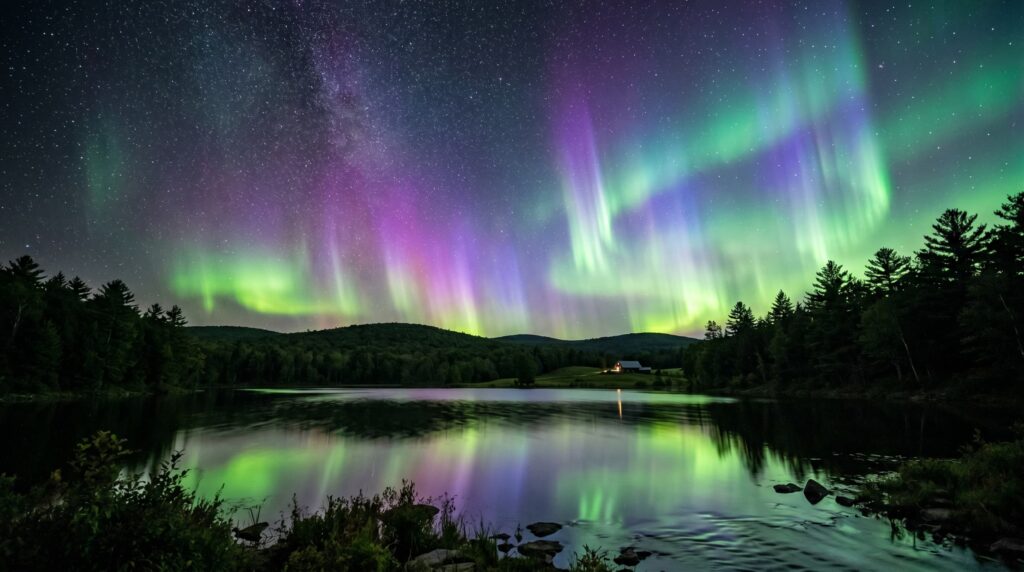
Northern Lights Visibility 2026: Why Solar Flares Are Making This Summer Unforgettable
If you’ve been tracking northern lights visibility 2026, you already know this summer has been something else entirely. I stepped outside on the night of June 4th expecting nothing — and there it was, a faint green smear dancing above my neighbor’s roofline in northern Pennsylvania. It was the last thing I expected in June. And honestly, it made me want to understand exactly what’s going on up there.
So what triggered all of this? And more importantly, how do you make sure you don’t miss the next show? Let me break it all down for you.
What’s Driving Northern Lights Visibility 2026 Right Now
Three solar flares burst from the sun toward Earth earlier this month, and the enormous beams of energy, light, and high-speed particles increased the odds of seeing the northern lights for people across the United States. That’s not a once-a-season event. That’s the new normal — at least for now.
NOAA’s Space Weather Prediction Center issued a strong G3 geomagnetic storm warning for June 4 through June 5, as multiple coronal mass ejections (CMEs) barreled toward Earth. Forecasters said some of the incoming eruptions may merge before arrival in a phenomenon known as a “cannibal CME,” which could further intensify the storm’s impact. I’d never heard that term before, and I found it both terrifying and kind of incredible.
During G3 geomagnetic storm conditions, auroras can become visible in mid-latitudes as far south as Illinois and Oregon. And if conditions tipped toward G4? Northern lights have been seen as far south as Alabama and Northern California under G4 geomagnetic storm conditions. That’s a huge swath of the country suddenly in play.
The deeper reason all of this is happening comes down to the sun’s own natural rhythm. The sun follows a roughly 11-year solar cycle, alternating between periods of solar minimum and solar maximum. During the solar maximum phase, the number of sunspots increases, and these regions can produce solar flares and coronal mass ejections, sending charged particles streaming toward Earth.
We are currently near the peak of Solar Cycle 25, which arrived earlier and stronger than predicted — the May 2024 Gannon Storm (Kp 9) was the strongest in 20 years and produced aurora visible from Mexico and Hawaii. That 2024 event was my first real wake-up call. But from what I’ve seen this year, 2026 is keeping that energy alive.
The smoothed sunspot number currently sits at roughly 180–200 — well above initial predictions of around 115 — making 2026 one of the best years in a decade for northern lights viewing. Solar scientists now believe that Solar Cycle 25 will have a double peak, extending the window for aurora activity well into 2026. More peaks mean more chances for you to see something spectacular.
On top of that, NOAA issued a G3 geomagnetic storm watch for June 8, and a G2 watch for June 9, for the anticipated arrival of a CME that left the sun on June 6. So even after the early June burst, the sun wasn’t finished. Not even close. That’s what makes northern lights visibility 2026 so remarkable — the storms just keep coming.
You can follow all of this in real time on the NOAA Space Weather Prediction Center Aurora Dashboard, which is probably the most reliable free resource out there for tracking incoming activity.
How to Actually See the Northern Lights: Visibility 2026 Events
Knowing a storm is coming is only half the battle. The other half is positioning yourself to actually witness it. I’ve missed a few displays because I didn’t pay attention to the basics, and I don’t want you to make the same mistakes.
Here’s what you need to watch:
- The Kp index — this 0–9 scale measures geomagnetic activity globally. G1–G2 means aurora at high latitudes. G3 or higher means mid-latitude aurora — worth checking if your city is in the visibility zone.
- The Bz component — a negative Bz (below 0) is favorable for aurora activity. Values below -10 nT typically trigger strong aurora displays.
- Solar wind speed — faster solar wind (above 500 km/s) increases the chance of aurora activity.
- Cloud cover — aurora forms 100 km up. Clouds hide everything. Use a forecast map to find clear skies, even if it means driving an hour.
- Moon phase — full moons wash out faint lights. Always check the moon phase before you head out.
NOAA’s official aurora dashboard provides users with information about current aurora activity. The Space Weather Prediction Center offers a scientifically grounded, real-time aurora borealis forecast using the OVATION Prime model. It’s where I check first, every time.
A short-term forecast of about 30 minutes is available on NOAA’s Aurora 30-Minute Forecast page. And SWPC’s Aurora Dashboard collects all of the agency’s products and information in one place. That’s genuinely useful when conditions are changing fast.
For timing, local midnight — roughly 10 PM to 2 AM local time — remains the optimal viewing window, when the auroral oval is typically most overhead. Get out of the city if you can. Even suburban light pollution can wash out a moderate display. And if you want to photograph what you see, the aurora often looks brighter on camera than to the naked eye — use a tripod, manual focus, and a fast lens to reveal the full color.
I also find the University of Alaska Fairbanks Aurora Forecast incredibly helpful for a slightly more academic read on what’s coming. And for a deeper dive into the solar cycle data behind all of this, the NOAA Solar Cycle Progression page is worth bookmarking.
Northern Lights Visibility 2026: What Can Go Wrong (And What to Expect)
Here’s the truth — aurora chasing can frustrate you. I’ve driven two hours to a dark sky site and seen nothing but clouds. And sometimes, a forecast storm fizzles. So what are the real watch-outs with northern lights visibility in 2026?
Aurora borealis is a natural phenomenon, and prediction cannot be 100% accurate. No tool or app can tell you precisely when, where, or exactly how you will see the lights. Even NOAA’s best models have limits. That’s just the reality of space weather.
There’s also the June problem. Summer brings shorter nights in northern latitudes, which squeezes your viewing window dramatically. Activity remains elevated for roughly 2–3 years around the solar peak, so 2026 should still be an active year for aurora, particularly in its first half. That means if you’re reading this in late summer or autumn, you’re actually in a pretty good position — darker nights return just as the solar activity remains elevated.
What you should watch out for:
- Overreliance on long-range forecasts — NOAA issues storm watches only 1–3 days before expected arrival based on CME detections. Anything beyond that is probably too speculative to plan around.
- Assuming G3 means guaranteed visibility, storm intensity, and local weather, both matter. You need both a strong storm and clear, dark skies.
- Ignoring the declining cycle trend — in 2026, we’ll see fewer sunspots, solar flares, and CMEs than at the cycle peak, but that doesn’t mean chances for strong auroras are over.
- Missing the autumn window, from late August 2026 to December 2026, is also a great time to catch displays, with longer nights back in your favor.
The upside? Based on current solar cycle forecasts, 2026 is widely expected to be one of the strongest years for northern lights activity in more than a decade. NASA and NOAA have confirmed that the Sun has entered a period of heightened activity, during which solar flares and geomagnetic storms occur more frequently. The odds are genuinely in your favor right now in a way they haven’t been since 2003. You’d be remiss not to try.
For real-time space weather data beyond the basics, SpaceWeatherLive gives you a clean, constantly updated look at Kp, Bz, and incoming CME data.
Final Word
Northern lights visibility in 2026 is, without exaggeration, one of the most accessible aurora opportunities of the past two decades. The combination of Solar Cycle 25’s extended peak, recurring solar flares, and storms reaching G3 and potentially G4 levels means the sky is genuinely putting on a show.
My advice? Don’t wait for a “perfect” night. There’s no such thing. Set up your NOAA alerts, check the Kp index, find a dark spot within driving distance, and get out there when conditions line up — even partially. The times I’ve seen the lights were rarely the ones I’d perfectly planned. They were the ones where I just showed up.
The current Solar Cycle 25 peak is the best aurora opportunity many people will see in their lifetime, given that the next cycle isn’t expected to peak until 2034–2036. That’s a decade-long wait if you miss this window. So whether you’re in Montana, Michigan, or Maine, northern lights visibility 2026 is real, it’s here, and it’s worth every cold night and dark road it takes to witness it.
Frequently Asked Questions About Northern Lights Visibility 2026
What causes solar flares to increase northern lights visibility?
Solar flares release massive bursts of charged particles that travel toward Earth and interact with our planet’s magnetic field, creating the glowing displays we call the northern lights. The stronger the flare, the farther south that visibility can extend, sometimes reaching states and countries that rarely see auroras at all.
Is it safe to watch the northern lights during a solar flare event?
Yes, watching the aurora is completely safe for people on the ground — the Earth’s atmosphere and magnetic field absorb the harmful radiation long before it reaches you. The only real risks from strong solar flares are to satellites, power grids, and radio communications, not to skywatchers enjoying the show.
How can I find out when and where to see the northern lights in 2026?
The best way to track northern lights visibility in 2026 is to monitor NOAA’s Space Weather Prediction Center, which issues real-time geomagnetic storm alerts and Kp index forecasts. Apps like SpaceWeatherLive and My Aurora Forecast also send push notifications when aurora activity is strong enough to be visible in your area.
How do 2026 solar flares compare to previous years for aurora viewing?
2026 falls near the expected peak of Solar Cycle 25, which scientists have noted is tracking stronger than initially predicted, making northern lights visibility in 2026 potentially more frequent and widespread than in previous years. Compared to the quieter solar minimum years around 2019–2020, skywatchers today are experiencing significantly more aurora events at lower latitudes.
Do you need to travel to Alaska or Norway to see the northern lights?
This is one of the most common misconceptions — during strong solar flare events tied to high geomagnetic activity, the northern lights can be visible as far south as the northern United States, central Europe, and even occasionally the UK and northern France. You don’t always need an expensive polar expedition; staying informed about space weather alerts and finding a dark sky away from city lights can be enough during an active flare period.