The 2026 Strait of Hormuz Crisis: A Deep Dive into the World’s Biggest Energy Shock
Tracking geopolitical energy risk for years prepares you for market volatility, but the ongoing Strait of Hormuz crisis that unfolded in early 2026 represents an economic shock of a completely different magnitude. Nothing in recent memory—neither the 2022 invasion of Ukraine nor the Red Sea shipping disruptions—matches the systemic risk of this chokepoint’s instability.
This is no longer a localized security issue. It has rapidly evolved into a global inflation story, a supply chain bottleneck, and a major headwind for macro stability. To understand why this bottleneck is so critical, look at the physical and structural reality of the channel itself.
What the Strait of Hormuz Closure Actually Means in Numbers
The Strait of Hormuz sees an average of 20 million barrels per day of crude oil and oil products, representing around 25% of the world’s seaborne oil trade. People throw that stat around, but let me make it concrete for you — that’s roughly one in four barrels of maritime oil on Earth funneling through a passage just 21 miles wide at its narrowest point.
The strait has two shipping lanes, each about two miles across, separated by a two-mile buffer — that’s the entire passage connecting the Persian Gulf to the open ocean. For a waterway that carries a fifth of the world’s total oil consumption, that’s an almost absurdly narrow margin for global civilization to balance on.
And it’s not only oil. A closure of the Strait also has significant implications for global gas trade, stranding LNG exports from Qatar and the UAE, which together represent almost 20% of global LNG exports. When you think about what that means for European heating, Asian manufacturing, and global fertilizer production all at once, the exposure is staggering.
Here’s what most people get wrong about the Strait of Hormuz closure: they assume the world can just reroute. It can’t. Unlike the Strait of Malacca, which has geographically proximate alternatives, traffic through the Strait of Hormuz cannot be rerouted — it is the only maritime gateway to the Persian Gulf, where major oil producers Iran, Iraq, Kuwait, Saudi Arabia, and the UAE export most of their oil.
In 2024, exports of crude and condensate from Saudi Arabia alone accounted for 38% of total Hormuz crude flows at 5.5 million barrels per day. Saudi Arabia, Iraq, the UAE, Iran, and Kuwait together account for more than 93% of total Hormuz crude flows. These aren’t countries with easy workarounds.
The destination data makes Asia’s vulnerability impossible to ignore. Around 84% of the crude oil and condensate and 83% of the LNG that moved through the Strait went to Asian markets in 2024, with China, India, Japan, and South Korea accounting for a combined 69% of all Hormuz crude oil flows. For Japan specifically, approximately 90–95% of Japan’s crude oil comes from the Middle East, and roughly 70–74% of its total crude imports pass through the Strait of Hormuz directly.
For verified data on global oil chokepoints from the U.S. government, see the EIA’s World Oil Transit Chokepoints analysis.
How the Strait of Hormuz Closure Unfolded — and Where Things Stand
Shipping traffic has been largely blocked since February 28, 2026, when the United States and Israel launched an air war against Iran. In retaliation, Iran launched missile and drone attacks and the IRGC issued warnings forbidding passage, boarded and attacked merchant ships, and laid sea mines in the strait.
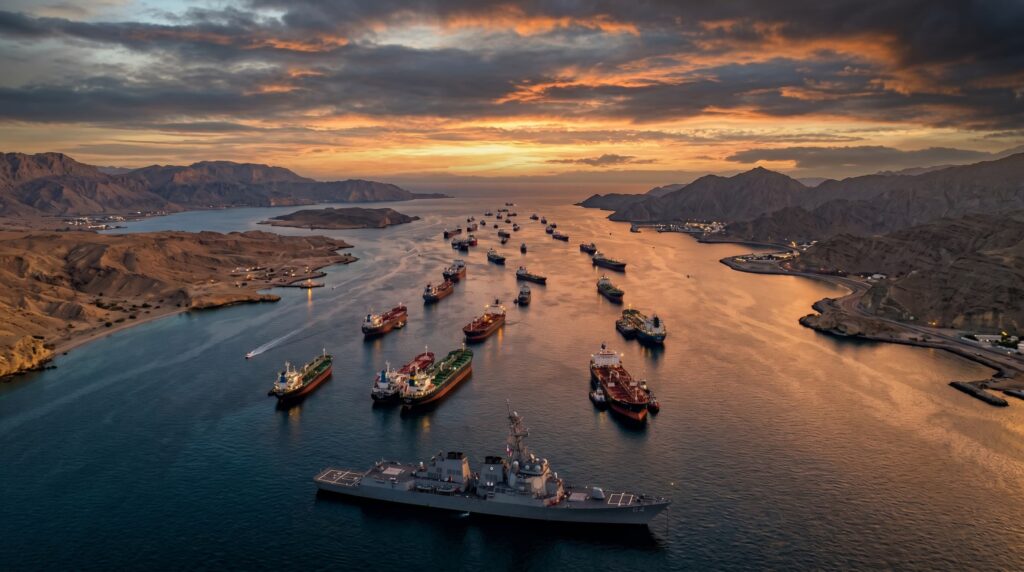
Tanker traffic dropped first by about 70%, with over 150 ships anchoring outside the strait to avoid risks, and soon afterwards, traffic dropped to about zero. Think about that. The historical daily average is 138 ships passing through. It went to zero.
The largest-ever monthly increase in oil prices occurred in March 2026. The closure of the strait became the largest disruption to world energy supply since the 1970s energy crisis, as well as the largest in the history of the world oil market. This is similar to the 1973 Arab oil embargo, but arguably more severe — because back then, alternatives existed and the disruption wasn’t a physical blockade backed by mines, drones, and missiles.
Following the closure of the Strait of Hormuz on March 4, 2026, Brent Crude surged past $120 per barrel, and QatarEnergy declared force majeure on all exports. Brent futures peaked near $118–$120 per barrel in March 2026 — roughly a 64% spike from pre-closure levels around $72 per barrel.
The cascade hit fast. Fertilizer represents one of the biggest downstream risks — roughly one-third of global fertilizer trade transits the Strait of Hormuz, including large volumes of nitrogen exports. New Orleans fertilizer hub urea prices have already risen from $475/metric ton to $680/metric ton. You feel that at the grocery store within a season.
Qatar accounts for nearly one-third of the world’s helium supply, produced as a byproduct of its natural gas processing. As supply tightens, the effects are rippling through global technology supply chains — helium plays a critical role in semiconductor manufacturing.
So when you see that your phone upgrade is delayed or your electricity bill jumped, the Strait of Hormuz closure is part of that story. For the IEA’s current emergency response framework, see the IEA’s Strait of Hormuz resource page.
What Governments and Markets Got Wrong About the Strait of Hormuz Closure
From what I’ve seen in covering energy markets, the biggest mistake analysts made was assuming Iran would never actually pull the trigger. The risk was priced in as tail risk — something to hedge against, not plan for. That assumption was wrong.
Blockage of the strait had long been understood as a risk, but this blockage proceeded differently than the Trump administration appears to have planned for. Iran demonstrated that threats and a few attacks can effectively block traffic through the Strait. The IRGC didn’t need to sink the entire fleet — they just needed to make insurance unavailable.
Insurance became unavailable or prohibitively expensive for vessels transiting the strait, and seafarers were unwilling to make the journey, meaning the strait was effectively closed. That’s an asymmetric warfare masterstroke (grim as it is to acknowledge). Iran didn’t close the world’s most important waterway with warships — they closed it with actuaries.
The bypass pipelines are real but wildly inadequate. The IEA estimates that only 3.5 to 5.5 million barrels per day can be redirected through Saudi and Emirati pipelines outside Hormuz, which still leaves a very large gap. Beginning with a baseline of 20 million barrels per day and subtracting 3.5 to 5.5 million, the implied net shortfall is roughly 14.5 to 16.5 million barrels per day.
The closure of the Strait of Hormuz has led to the largest oil market disruption in history. Global oil supply crashed by 10.1 million barrels per day in March, and global oil output is expected to fall by 6.9 million barrels per day year-on-year in Q2 2026 — recording its largest quarterly decline since the COVID-19 pandemic.
A Dallas Federal Reserve analysis found that a cessation of oil exports from the Persian Gulf lasting only one quarter would raise the average WTI price to $110 per barrel in April 2026 — while an outage lasting two quarters would cause the WTI price to peak at $132 per barrel. These aren’t worst-case scenarios. These are baseline projections.
See the full Congressional Research Service report on Iran conflict and Strait of Hormuz impacts on oil, gas, and commodities for a detailed policy breakdown. And the World Bank’s oil market disruption analysis has the most current supply forecasts.
Where the Strait of Hormuz Closure Stands Right Now
As of mid-June 2026, there’s genuine reason for cautious optimism — but don’t exhale completely yet. New ceasefire conditions for a period of 60 days were agreed upon on June 12, with the presidents of the US and Iran signing on June 17 a memorandum of understanding to end the war.
US officials said the agreement includes Iran reaffirming a commitment not to develop a nuclear weapon, an end to the war on all fronts, and the reopening of the Strait of Hormuz. But on June 20, Iran announced a renewed closure of the Strait of Hormuz, citing Israeli actions as a violation of its agreement with the US — a claim the US military denied. So the situation remains active and volatile.
Oil tanker and cargo ship traffic won’t ramp back up to prewar levels until weeks after the United States and Iran sign the deal. And once it opens, the market will take months to normalize. You should plan around energy prices staying elevated well into 2027.
Final Word
I’ve watched a lot of energy crises play out from a distance. The Strait of Hormuz closure is different — it’s the one that energy analysts spent decades warning about, and now it’s actually happening. The strategic fragility was always there. It just took one military conflict to make it real.
What you need to understand is that this isn’t over when the shooting stops. Brent is expected to average $86 per barrel in 2026 before dropping to $70 in 2027 as supply stabilizes — and that assumes the conflict resolves cleanly. Every week that the Strait of Hormuz closure continues, the economic damage compounds. Mines need clearing, ships need repositioning, insurance markets need rebuilding, and supply chains need months to recover.
If you take nothing else from this, take this: the world just learned that 25% of its seaborne oil trade passes through a passage two miles wide, and there’s essentially no backup plan. That lesson will shape energy policy, geopolitics, and your energy bills for years to come. The Strait of Hormuz closure isn’t just a headline — it’s a fundamental reckoning with how thin the margins of global energy security really are. For the latest coverage, follow reporting at CNBC’s Strait of Hormuz coverage.
Frequently Asked Questions About Strait of Hormuz Closure
What is the Strait of Hormuz, and why does its closure matter?
The Strait of Hormuz is a narrow waterway between Iran and Oman that connects the Persian Gulf to the Gulf of Oman and the Arabian Sea. It is the world’s most critical oil transit chokepoint, with roughly 20% of global oil supply passing through it daily. A Strait of Hormuz closure would immediately disrupt energy supplies to Asia, Europe, and beyond, triggering a cascade of economic consequences worldwide.
How much would oil prices rise if the Strait of Hormuz were closed?
Analysts estimate that even a brief blockage could send oil prices surging by 50% or more within days, with some projections pointing to prices exceeding $150 per barrel. The exact spike would depend on the duration of the disruption and how quickly strategic petroleum reserves could be released by major economies. A prolonged Strait of Hormuz closure lasting weeks or months could push prices to historic highs not seen since the 1973 oil embargo.
How do countries prepare for a potential Strait of Hormuz closure?
Governments and energy companies maintain strategic petroleum reserves specifically designed to offset short-term supply shocks from events like a chokepoint disruption. Several Gulf states, including Saudi Arabia and the UAE, have invested in alternative pipelines that bypass the strait entirely, allowing some oil to reach export terminals without passing through the waterway. International naval coalitions also regularly patrol the region to deter threats and keep shipping lanes open.
How does the Strait of Hormuz compare to other global oil chokepoints?
While chokepoints like the Suez Canal and the Strait of Malacca are critically important, the Strait of Hormuz carries a far greater volume of crude oil than any other single passage in the world. The Suez Canal handles significant container and tanker traffic, but no other chokepoint has the same concentration of pure petroleum exports flowing through it daily. This makes Hormuz uniquely irreplaceable in the short term, as alternative shipping routes would add weeks and enormous cost to delivery times.
Is Iran actually capable of closing the Strait of Hormuz?
A common misconception is that Iran could seal off the strait completely and indefinitely, but a full, sustained closure is considered extremely unlikely given the presence of U.S. and allied naval forces in the region. Iran does have the military capability to significantly disrupt or threaten shipping through mines, missiles, and fast-attack boats, which alone would cause massive market panic. Most security experts agree that even a partial disruption rather than a total Strait of Hormuz closure would be enough to shock global energy markets and destabilize regional economies.