The Shocking B-52 Crash at Edwards Air Force Base That Killed All 8 Aboard
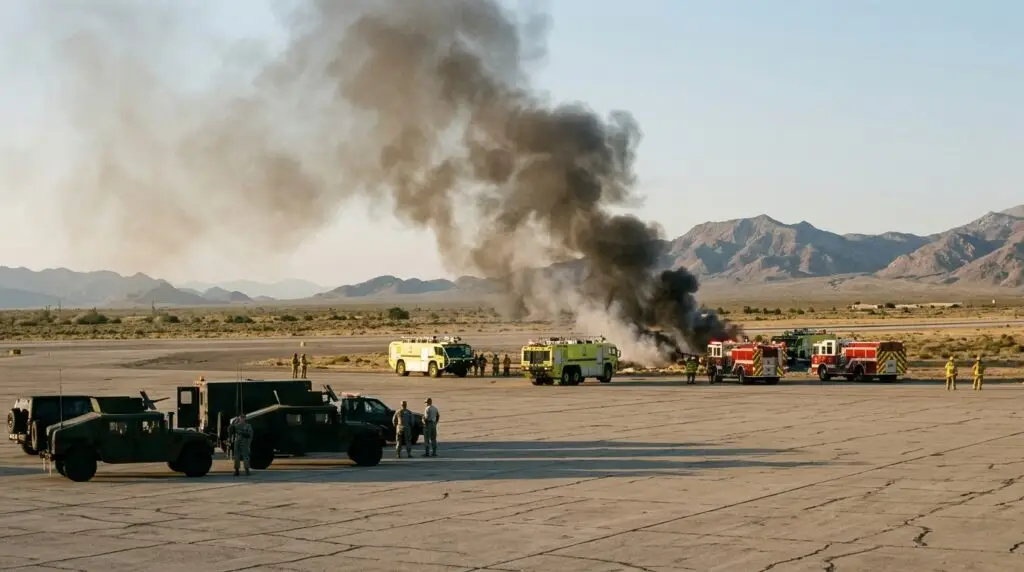
The B-52 crash at Edwards Air Force Base hit the news on June 15, 2026 — and I honestly couldn’t look away. I was scrolling through my feed just after noon when the first reports started trickling in, and within an hour, the story had consumed every major outlet. A towering black plume of smoke, a blackened scar carved into the Mojave Desert runway, and eight families whose lives changed forever before lunchtime.
A mammoth military plane on a routine test mission crashed shortly after takeoff, killing all eight crew members on board and leaving charred wreckage so mangled it was barely recognizable. Eight people. Gone in seconds. And right at one of America’s most celebrated and historically significant air bases.
So what do we actually know? And why does this crash matter beyond the immediate tragedy? I’ve been digging through every verified report I can find, and here’s the full picture.
Critical Facts About the B-52 Crash at Edwards Air Force Base
The Boeing B-52 Stratofortress took off at around 11:20 a.m. local time, the base confirmed. The crew was embarking on a test mission for the Air Force’s Radar Modernization Program when the plane took off. This wasn’t a combat sortie. It was supposed to be a controlled, measured test flight — the kind these crews ran regularly. That makes it even more gut-wrenching to read about.
The crash was deemed unsurvivable based on a review of footage, according to Col. James Hayes, deputy commander for the 412th Test Wing at the base, calling it a “horrible tragedy.” You don’t often hear military officials use that kind of language publicly. When they do, you know the situation was truly devastating.
Everyone on board was killed: four crew members, one civilian, and three contractors, officials said. The group was acting as a Combined Test Force, or CTF, which the airfield described as a unique construct where active-duty airmen work with military contractors and government civilians to complete specific projects. That mixed composition of the crew tells you something important — this wasn’t just a military loss. It was a national one.
It is also the deadliest crash of a B-52 since 1982, when one crashed at Mather Air Force Base in Sacramento County, California, killing all nine crew members. Think about that. More than four decades passed between the two deadliest B-52 accidents in American history. And now we’re here again.
The Victims of the B-52 Crash at Edwards Air Force Base — Who Were They?
The victims were identified as Col. Gregory Watson, 53, weapon systems officer, Boeing; Lt. Col. Gabriel Estrella, 40, weapon systems officer, Air Force Operational Test and Evaluation Center; retired Lt. Col. Miles Middleton, 50, pilot, Boeing; Maj. Alexander Davis, 34, weapon systems officer, 419th Flight Test Squadron; Maj. Robert Dee, 40, pilot, 419th Flight Test Squadron; Maj. Brad Hovey, 35, pilot, 419th Flight Test Squadron; Jeromy Smith, 32, flight test engineer, 419th Flight Test Squadron; and Christopher Rischar, 41, flight test engineer, JT4 contractor.
Read those names. Read those ages. The youngest was 32 years old. These were not abstractions — they were fathers, husbands, mentors. “They were dedicated professionals, beloved family members and irreplaceable teammates,” Col. Thomas Tauer, 412th Test Wing Commander, said in a statement.
Two Boeing employees were among the victims. Boeing said in a statement, “The loss of Miles and Greg is deeply felt across our teams, and our hearts remain with their families.” I’d say that grief extends well beyond Boeing’s offices right now.
What the B-52 Crash at Edwards Air Force Base Reveals About the Modernization Program
Here’s the part of the story I don’t think enough people are talking about. This wasn’t just a tragic accident — it happened in the middle of a massive, expensive, strategically critical overhaul of America’s oldest operational bomber. The crew was conducting a routine test mission to support the Air Force’s sweeping modernization program for the B-52 fleet, which includes evaluating a new radar system, upgraded avionics, and new Rolls-Royce engines designed to keep the bomber operational into the 2050s.
In January, the Air Force awarded Boeing a roughly $2 billion contract to modify and test two B-52s equipped with the new engines ahead of a planned fleetwide upgrade. So the stakes here are not just human — they’re financial, strategic, and symbolic. The B-52 is the backbone of America’s nuclear deterrent. It can fly 8,800 miles without refueling and can carry heavy payloads, making it a vital military aircraft. “It’s a part of the backbone of the nuclear triad for the United States military,” said Luis Martinez, ABC News’ senior Pentagon reporter.
According to the official Edwards Air Force Base release, the base released the names of all eight fallen crew members after next-of-kin notifications were complete. The airfield remained closed until at least Thursday, and flight test operations were expected to resume early the following week. Every day of downtime has cascading effects on a program this size.
B-52 crash at Edwards Air Force Base, investigators now face a technically complex task. As the Air Force paused flight test operations at the base, the investigation was expected to focus heavily on the aircraft’s takeoff, looking for potential engine failures or controllability issues. That investigation, per officials, could take six months or more. You won’t get answers fast here.
The Dangerous Legacy of Test Flight at Edwards — What You Need to Know About the B-52 Crash at Edwards Air Force Base
Look, I want you to understand the context here, because it matters. Edwards isn’t just any base. Edwards Air Force Base is historically used as a testing site — not just for Air Force planes, but for other aircraft, helicopters, drones, and even space shuttles because of its long runways. As one expert put it, “If it flies, it’s tested at Edwards Air Force Base,” said Richard Kolko, a retired US Navy commander and pilot. “It’s got some of the best test pilots and best engineers out there.”
And yet, the B-52 crash at Edwards Air Force Base proves that even the best can face unsurvivable situations. The aircraft involved in the accident was 60-0061, a Boeing B-52H Stratofortress assigned to the 412th Test Wing. In December 2025, Edwards Air Force Base said the aircraft had flown from Port San Antonio to the base after receiving an upgraded radar system as part of an ongoing modernization program. The irony is painful — the plane was there specifically because it had just been upgraded.
The accident was the first crash of a B-52 since 2016, when one crashed at Andersen Air Force Base in Guam, injuring the seven crew members. That 2016 accident had no fatalities. This one left no survivors. The difference in outcome and the fact that the cause is still under investigation is something that will weigh on the entire test aviation community for years.
As reported by ABC News’ coverage of the identified victims, officials confirmed the mixed civilian-military crew composition that’s standard for a Combined Test Force mission. What should you take away from that? These missions carry a real risk that extends beyond uniformed service members. Contractors and civilians sign up for that risk too — and their sacrifice deserves the same recognition.
Here’s a difficult question worth sitting with: Should the B-52 modernization program continue on its current timeline, or should the investigation findings trigger a mandatory pause? According to CNN’s reporting on the B-52 crash, officials are expected to resume flight test operations early the week after the crash. That’s a fast turnaround for a program that just suffered its worst loss in decades. I’m not saying it’s wrong — but it’s worth asking.
The factors that make the B-52 crash at Edwards Air Force Base so significant include:
- It’s the deadliest crash involving a B-52 bomber since 1982.
- It occurred during active testing of the Radar Modernization Program, meant to upgrade B-52 bombers so the planes can continue flying into the 2050s.
- The crew included both uniformed military, government civilians, and contractors.
- The wreckage was so severe that officials called it unsurvivable within hours of impact.
- The Boeing-made bomber has not been in production since 1962, though several life-extension initiatives have modernized the airframe and kept it flying.
The response from leadership has been fast and emotional. Secretary of the Air Force Troy E. Meink and House Speaker Mike Johnson both shared their condolences on social media about the lives lost. California Gov. Gavin Newsom also offered his sympathies to “the entire Edwards Air Force Base community” and thanked first responders.
The test wing has stood up an Emergency Family Assistance Center to provide support, like mental health services, childcare assistance, legal counsel, and chaplain support for anyone at Edwards Air Force Base, according to the Air Force. That’s the right call. Grief hits differently when it hits a tightly knit base community like this one.
For more technical background on the B-52 Stratofortress and its operational history, the U.S. Air Force’s official B-52 fact sheet is one of the most authoritative sources available. And for the ongoing investigation process, the National Transportation Safety Board provides a framework for understanding how military aviation accident investigations are typically structured and what they aim to uncover.
Final Word on the B-52 Crash at Edwards Air Force Base
The B-52 crash at Edwards Air Force Base is more than a headline. It’s a reminder — a brutal, clarifying one — that the people who push America’s military technology forward do so at extraordinary personal risk. Eight professionals, ranging from a 32-year-old flight test engineer to a 53-year-old Boeing colonel, gave their lives doing work that most of us will never fully understand or appreciate.
If you take one thing away from this, make it this: the next time you read about a weapons system upgrade, a radar modernization contract, or a test flight out of a desert base, remember that real people are in those cockpits. They’re not abstractions. They have names, ages, families, and four-year anniversaries.
The investigation into the B-52 crash at Edwards Air Force Base will take months. The answers may raise more questions. But the loss is already certain — and it deserves to be remembered long after the smoke clears from that Mojave Desert runway.