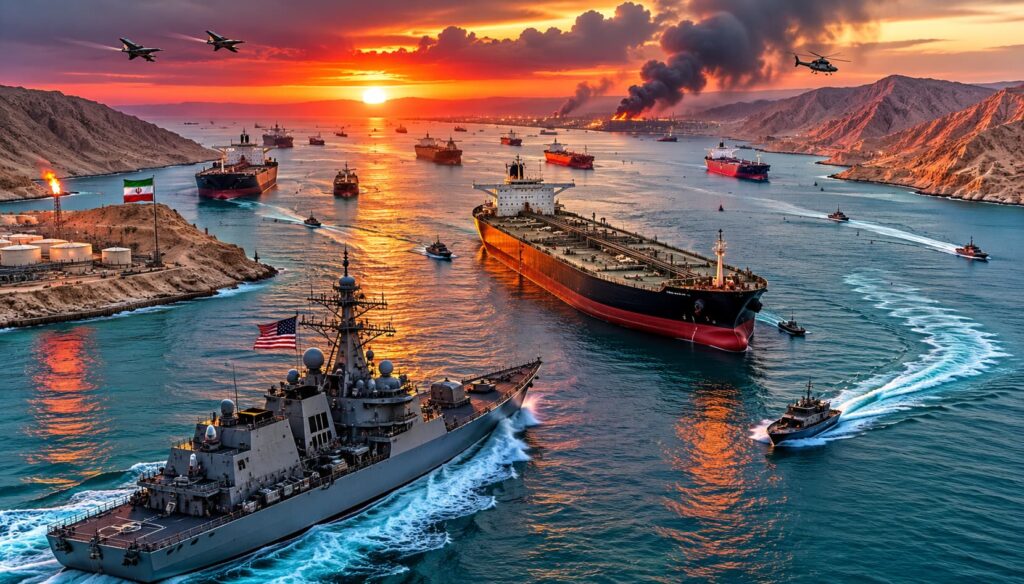
The Strait of Hormuz Crisis Just Got Real — Again
The Strait of Hormuz crisis hit a dangerous new flashpoint this weekend, and I’ll be honest — when I woke up to the news on Saturday, June 20, 2026, my stomach dropped. Iran declared the strait closed again, just days after a fragile truce seemed likely to hold. And right at that same moment, VP JD Vance was boarding a plane to Switzerland to try to save the deal.
You probably felt that same sense of dread, right? The kind where you think: didn’t we get good news? Well, here’s the full picture of what’s happening, what it means for you, and what to actually watch.
Understanding the Strait of Hormuz Crisis: How We Got Here
On February 28, 2026, the United States and Israel initiated coordinated airstrikes on Iran under Operation Epic Fury, targeting military facilities, nuclear sites, and leadership. That’s when this whole nightmare began. And Iran’s response was predictable — and devastating.
The Iranian Revolutionary Guard Corps (IRGC) issued warnings forbidding passage through the strait, boarded and attacked merchant ships, and laid sea mines in the strait. The Strait of Hormuz crisis was no longer a threat. It was a reality.
Until the US–Israeli war against Iran, the Strait of Hormuz was open, and about 25% of the world’s seaborne oil trade and 20% of the world’s liquefied natural gas (LNG) passed through it. So you can imagine what happened when that flow essentially stopped.
The conflict caused the restriction of nearly all traffic through the Strait of Hormuz, leading to what the International Energy Agency characterized as the “largest supply disruption in the history of the global oil market.” I want you to sit with that for a second. Largest. In history.
Things got so bad so fast. Tanker traffic dropped first by about 70%, with over 150 ships anchoring outside the strait to avoid risks. Maritime traffic in the strait was reduced to a trickle due to the threat of Iranian missiles, drones, and mines, reducing the global oil supply by an estimated 14 million barrels each day.
From a pure energy market standpoint, the Strait of Hormuz crisis has been catastrophic. The Brent crude oil spot price averaged $107 per barrel in May — oil prices fell in May only as numerous reports surfaced that the United States and Iran were nearing an agreement to extend the ceasefire and reopen the Strait of Hormuz. For context, analysts forecast that prices could reach $100 per barrel if disruptions persisted, potentially adding 0.8% to global inflation.
And it’s not just oil you need to worry about. Up to 30% of internationally traded fertilizers normally transit the Strait of Hormuz. That means food prices. Your grocery bill. This thing touches everything. You can track live energy data from the U.S. Energy Information Administration’s June 2026 Short-Term Energy Outlook, which lays out exactly what disruptions mean for prices ahead.
A brief ceasefire gave markets hope. On June 17, Trump and Iranian President Masoud Pezeshkian signed the memorandum of understanding to end the war. Pakistan announced the MoU implied Tehran would promptly reopen the Hormuz Strait and that the American blockade of Iranian ports would cease immediately. Markets exhaled. But then Saturday happened.
Strait of Hormuz Crisis Flares Again: What the Switzerland Talks Mean for You
Iran’s top joint military command ordered that the Strait of Hormuz be closed in retaliation for what it claims is a “blatant breach” of the recently signed US-Iran Memorandum of Understanding. So even with ink barely dry on a deal, the Strait of Hormuz crisis was reignited.
Iran’s joint military command said the closure of the strait was in response to continued Israeli military operations in Lebanon and what it described as U.S. “bad faith” and a failure to uphold commitments under the truce framework. And here’s the thing — the US pushed back hard.
“Iran does not control the Strait of Hormuz,” U.S. Central Command spokesperson Navy Captain Tim Hawkins told Reuters. “Traffic continues to flow, and U.S. forces are monitoring the situation to ensure this remains the case.” So you have two opposite stories on the same day. That’s the grey zone we’re all living in right now.
Meanwhile, Vance was already wheels-up. U.S. Vice President JD Vance landed Sunday in Switzerland to help formally launch negotiations with Iranian leaders over curbing Tehran’s nuclear program and building out the fragile interim deal to end the war in Iran. The talks are taking place at the Bürgenstock resort — the same scenic Swiss venue used for Ukraine peace discussions.
The framework was signed last week, and now top U.S. and Iranian negotiators are in a 60-day sprint to reach an agreement on the technical details that hold massive implications for the world economy and global security. Sixty days. That’s the window. And from what I’ve seen, it’s going to be bumpy.
Here’s what the two sides actually want, and it matters for understanding where the Strait of Hormuz crisis goes next:
- The US immediately wants to go into the nuclear issue. The Iranians want an end to the fighting in Lebanon.
- The U.S. would like the first round of talks to end with an Iranian invitation for UN inspectors to visit its nuclear sites, which were bombed by the U.S. and Israel.
- In return, the U.S. is willing to give Iran access to some of its frozen funds — starting with a $6 billion account in Qatar — to buy humanitarian goods.
- The signed memorandum of understanding had called for the immediate end to military actions by Israel in Lebanon and the full reopening of the strait without tolls imposed by Iran for at least 60 days.
Vance struck an optimistic tone earlier in the day, saying talks were advancing despite Iran’s latest threat. Speaking on Fox News, he said Jared Kushner and special envoy Steve Witkoff in Switzerland were working through the agreement’s technical details. I’d say cautious optimism is probably the right read — but don’t hold your breath.
You can follow the Congressional Research Service’s analysis of the Iran conflict and Strait of Hormuz impacts for a sober, non-partisan breakdown of the policy stakes. It’s worth bookmarking if you want real depth on what Congress is watching.
What You Should Watch — And What Could Go Wrong With the Strait of Hormuz Crisis
So what does all this mean practically for you? Here’s my honest read on the pressure points — and the tripwires that could blow the whole deal apart.
The biggest risk right now is Lebanon. Earlier Saturday, Israeli strikes in southern Lebanon killed at least 16 people, including two children. Iran has made clear that Israeli action in Lebanon is its stated trigger for re-closing the Strait. So any escalation there could unravel the Switzerland talks instantly.
And the energy stakes of the Strait of Hormuz crisis can’t be overstated for everyday people. Here’s what I think you need to track:
- Oil prices: The Brent price averages $105 per barrel in June and July, as oil shipments remain limited and oil production and inventories fall.
- Inventory levels: Middle Eastern oil producers have cut output by over 11 million barrels per day, leading to large global inventory draws. As a result, oil inventories in OECD countries are the lowest since 2003.
- Food prices: The Strait of Hormuz is central to the global fertilizer trade. Over 30 per cent of global urea — widely used and produced from natural gas — is exported from Gulf countries through the strait.
There’s also the credibility question on both sides. “Iran announced the closure of the Strait, but it is not clear yet if that is more than rhetoric,” Daniel Shapiro, former U.S. ambassador to Israel and a senior fellow at the Atlantic Council, told Bloomberg. My gut says he’s right to flag that ambiguity. Iran closes the Strait rhetorically almost as a negotiating card.
And the domestic politics in the US are messy too. Trump and Vance have come under searing criticism from parts of their own party for the deal, with Republican hard-liners unfavorably likening it to a nuclear agreement signed by the Obama administration. So Vance is carrying political weight into Switzerland, not just diplomatic weight.
You can read live shipping and energy security analysis from CNBC’s June 20 coverage of the Strait of Hormuz closure and from World Oil’s breakdown of the latest closure announcement to get the market picture in real time.
Final Word
Here’s where I land on all of this. The Strait of Hormuz crisis is not resolved — not even close. We have a paper agreement, an ongoing war in Lebanon that neither side fully controls, and negotiations in a Swiss mountain resort that could collapse any morning. That’s the honest reality.
But I’d say there are reasons not to completely despair. Vance noted that “we actually got 16 million barrels of oil out of the Strait of Hormuz yesterday — that is a record going back to even before the conflict started.” Traffic is moving, even if Iran says otherwise.
What you should do: watch Lebanon, watch tanker traffic data, and watch what comes out of Bürgenstock in the next 48 hours. The Strait of Hormuz crisis is the hinge on which the global economy swings right now. Stay informed, stay calm — and know that the Strait of Hormuz crisis is far from the last chapter of this story.
Frequently Asked Questions About the Strait of Hormuz Crisis
What is the Strait of Hormuz, and why does it matter?
The Strait of Hormuz is a narrow waterway between Iran and Oman that connects the Persian Gulf to the open ocean. It is the world’s most critical oil chokepoint, with roughly 20% of global oil supply passing through it daily. Any Strait of Hormuz crisis that disrupts this passage can send shockwaves through energy markets worldwide.
How much would oil prices rise if Iran closed the Strait of Hormuz?
Analysts estimate that a full closure could push oil prices above $130 to $150 per barrel within days, depending on how long the blockade lasts. The current Strait of Hormuz crisis has already triggered volatility in futures markets, with prices spiking on news of Iran’s announcement. Beyond oil, shipping insurance costs and global supply chain disruptions add billions more in economic damage for every week the strait remains closed.
What is VP Vance doing in Switzerland, and how does it relate to Iran?
Vice President JD Vance is in Switzerland for diplomatic talks that U.S. officials say are aimed at de-escalating tensions with Iran and preserving open shipping lanes. The timing is significant because the talks began almost simultaneously with Iran’s announcement of the closure. Whether these negotiations can produce a quick resolution remains uncertain, but diplomats on both sides have signaled a willingness to keep communication open.
Has Iran closed the Strait of Hormuz before?
Iran has threatened to close the Strait of Hormuz many times over the past four decades, but has never followed through with a full, sustained closure. Past threats, including major standoffs in 2012 and 2019, led to military posturing but were ultimately resolved through diplomatic pressure and U.S. naval presence. This situation differs because it involves an actual announced closure rather than a threat, making it more serious than prior episodes.
Does the U.S. military have the power to reopen the Strait of Hormuz if Iran blocks it?
A common misconception is that the U.S. Navy can simply force the strait open overnight, but the reality is more complicated. While the U.S. Fifth Fleet is stationed in the region and has the firepower to escort vessels, doing so risks direct military confrontation with Iran. Reopening the Strait by force would likely require sustained operations and could escalate the conflict well beyond a regional dispute.