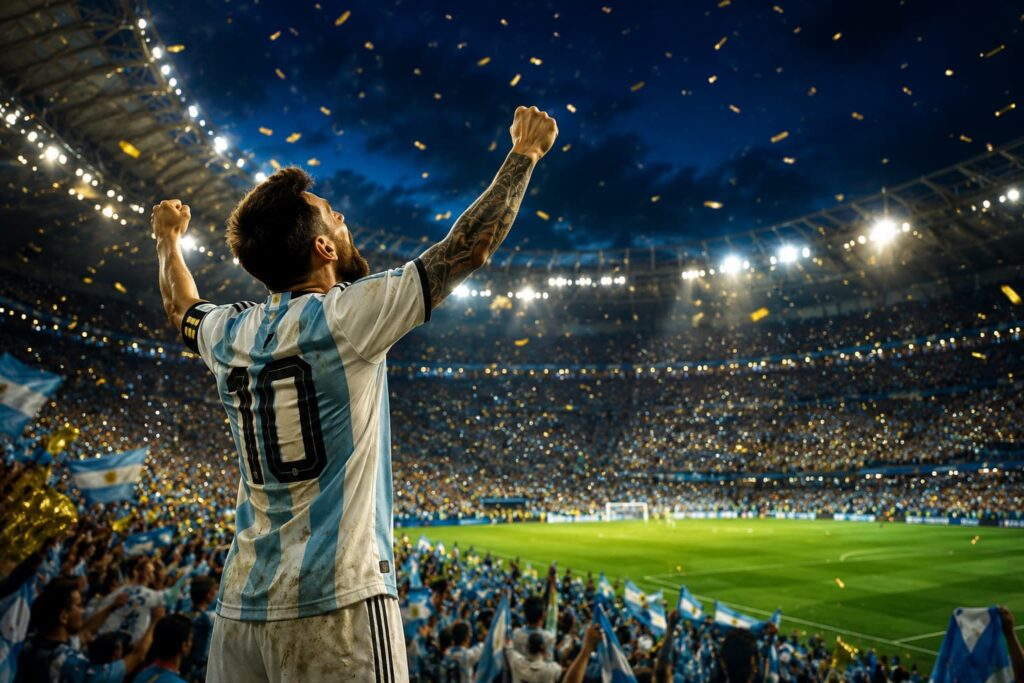
Watching Lionel Messi glide across a football pitch has always felt less like observing an athlete and more like witnessing history unfold in real time. But what transpired on Monday, June 22, 2026, went beyond pure sporting brilliance—it was a definitive rewriting of the history books. By scoring a monumental brace against Austria in the group stages of the 2026 tournament, the 38-year-old maestro didn’t just push Argentina forward; he shattered the all-time men’s World Cup scoring record, capturing his 17th and 18th career World Cup goals.
For years, analysts argued whether any player in the modern era could match the sheer tournament efficiency of legendary goalscorers. With his clinical double, Messi broke out of a tie with Miroslav Klose and stood entirely alone at the summit of global football. Understanding the tactical preparation, individual resilience, and broader economic impact of this milestone shows why this moment matters far beyond the stadium walls.
The Road to 18: Breaking Down the Modern Record
Before Monday’s match, the all-time scoring leaderboards for the men’s tournament had remained untouched for over a decade. Messi’s historic performance not only surpassed long-standing milestones but re-established what longevity looks like in professional sports. To cross-reference how his tally stacks up against the deepest archives of international football, you can consult the official FIFA World Cup Tournament Archive, which tracks every goal scored since 1930.
The elite tier of international goalscorers now sits as follows:
- Lionel Messi (Argentina): 18 Goals (6 Tournaments, 2006–2026)
- Miroslav Klose (Germany): 16 Goals (4 Tournaments, 2002–2014)
- Ronaldo (Brazil): 15 Goals (4 Tournaments, 1994–2006)
- Gerd Müller (West Germany): 14 Goals (2 Tournaments, 1970–1974)
What makes Messi’s ascension to the top of this list so remarkable is the evolution of his role. Unlike traditional penalty-box strikers like Klose or Gerd Müller, Messi has spent the better part of the last decade operating as an advanced playmaker, dropping deep into the midfield to engineer transitions while remaining lethal enough to finish them.
Anatomy of the Match: Resilience Under Pressure
From an analytical perspective, Monday’s match against a highly disciplined Austrian side was a masterclass in psychological resilience. The opening minutes did not hint at a historic evening. In the 9th minute, a rare missed penalty from Messi sent a shockwave through the stadium, threatening to derail Argentina’s attacking momentum.
However, true sporting excellence is defined by how an athlete responds to immediate failure. Rather than dropping his head, Messi adapted his positioning, exploiting the spaces left by Austria’s aggressive zonal marking system:
| Match Minute | Tactical Phase | The Execution |
|---|---|---|
| 9′ | Set Piece Failure | Missed penalty deflected off the left post. Austria gains temporary momentum. |
| 38′ | The Equalizer (Goal 17) | Latched onto a brilliant dummy pass from Thiago Almada, curling a left-footed strike into the bottom-right corner. |
| 90+2′ | The Record Breaker (Goal 18) | Capped off a clinical counter-attack with a delicate chip over an advancing goalkeeper to secure the victory. |
For a detailed breakdown of the advanced metrics, expected goals (xG), and player heatmaps from Monday’s historic fixture, you can explore FBref’s Advanced Football Statistics Hub.
The Longevity Dynamic: To understand the sheer scale of this achievement, consider that Messi scored his very first World Cup goal twenty years ago in 2006 against Serbia and Montenegro. Maintaining an elite, world-class goalscoring standard across six consecutive tournaments defies the typical biological limits of modern athletic careers.
3 Takeaways for Sports Media and Entertainment Publishers
For digital entrepreneurs and content creators, a historic sports milestone of this magnitude offers critical insights into how modern audiences consume major cultural events.
- Context Outperforms the Box Score: Audiences don’t visit independent sports blogs just to find out what the final score was; they can get that from a Google snippet. Readers crave narrative, deep tactical analysis, and historical context that ties the moment to a grander legacy.
- Leverage the Power of Longevity Narratives: Human beings are deeply drawn to stories of endurance and long-term mastery. Framing sporting achievements through the lens of a 20-year career arc generates much higher emotional engagement than treating a match as an isolated event.
- Prepare for Mobile Optimization First: During massive, breaking cultural moments, over 80% of traffic spikes hit from mobile devices as fans look up stats while watching live or arguing on social media. Ensuring your tables and lists render cleanly on mobile is essential for keeping bounce rates low and retaining ad revenue.
Frequently Asked Questions
How many total World Cup goals does Lionel Messi have now?
Following his clinical brace against Austria on June 22, 2026, Lionel Messi has accumulated a total of 18 career World Cup goals, making him the highest scoring male player in the history of the tournament.
Whose record did Messi officially break?
Messi surpassed the record previously held by Germany’s Miroslav Klose, who scored 16 goals across four World Cup tournaments between 2002 and 2014.
How does this impact the wider sports entertainment ecosystem?
Milestones of this caliber generate unprecedented global media traffic, driving record viewership across broadcast networks and triggering massive engagement spikes for digital publishers, sports digests, and streaming platforms worldwide. For broader real-time commentary and professional insights on how this changes the sports media landscape, read ESPN’s Global Football Coverage.