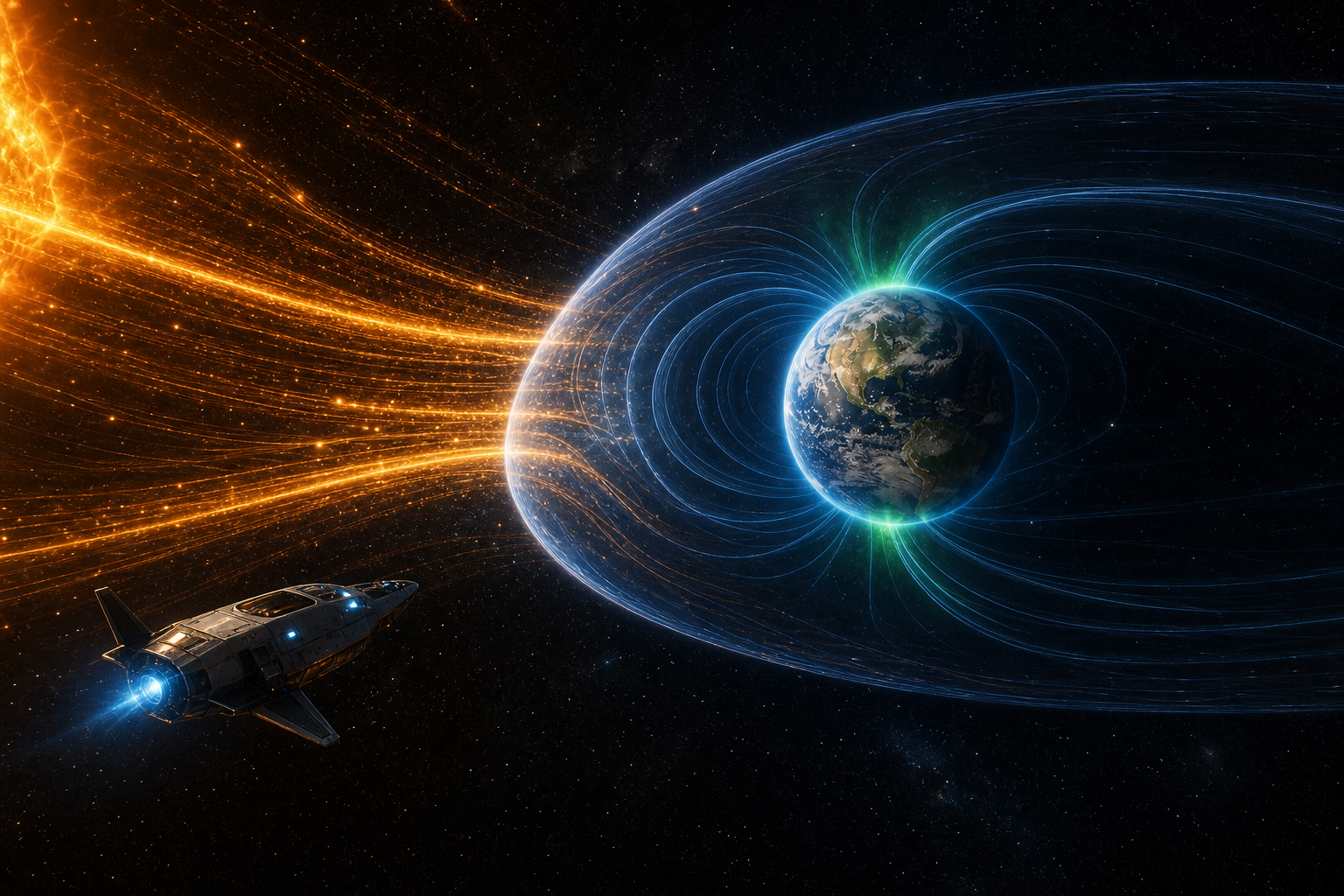
There is something extraordinary wrapped around our planet right now — a vast, invisible shield stretching thousands of kilometers into space, silently deflecting a relentless storm of charged particles that would otherwise render Earth completely uninhabitable. Humanity has known it exists for decades, built theoretical models of its behavior, and relied on it every single second of every single day. And yet, until now, nobody had ever actually photographed it. That is about to change.
A joint European and Chinese spacecraft known as Smile has successfully launched into orbit with one singular historic mission: to make the invisible visible, capturing the first-ever direct images of Earth’s magnetosphere. It is a scientific milestone that has been a long time coming — and the implications stretch far beyond a pretty picture of space.
What Exactly Is the Magnetosphere?
To understand why this mission matters so much, it helps to understand what the magnetosphere actually is and what it does for us every day without fanfare or recognition.
Deep within Earth’s core, the movement of molten iron generates an enormous magnetic field. That field radiates outward from the planet, forming a protective bubble that envelops the entire Earth. This bubble — the magnetosphere — acts as a planetary-scale force field against the solar wind, a constant stream of high-energy charged particles blasted outward from the Sun in all directions at staggering speeds.
Without this natural shield, the consequences would be catastrophic over geological timescales. The solar wind would gradually erode Earth’s atmosphere, stripping away the gases that make breathing possible and blocking the harmful radiation that sustains life. Some scientists believe this is precisely what happened to Mars, a planet that lost its magnetic field billions of years ago and is now a cold, barren, radiation-blasted world with an atmosphere too thin to support life as we know it.
Earth’s magnetosphere is, in a very literal sense, one of the primary reasons life exists here at all.
The Smile Mission: A Historic Collaboration
The spacecraft bearing the ambitious acronym Smile — Solar wind Magnetosphere Ionosphere Link Explorer — lifted off aboard a Vega C rocket, representing a landmark collaboration between the European Space Agency and China’s national space program. Partnerships of this scale between Western and Chinese space agencies remain relatively rare, making the mission notable not only for its scientific ambitions but also for its geopolitical symbolism.
The primary goal of the Smile mission is straightforward to describe but extraordinarily difficult to achieve: photograph and map Earth’s magnetosphere using specialized imaging instruments designed to detect the faint signals emitted when solar wind particles interact with the magnetic field boundary. These instruments will allow scientists to observe the magnetosphere’s shape, size, and behavior in ways that have never before been possible.
Specifically, researchers are eager to watch how the magnetosphere responds dynamically to changing solar wind conditions — how it compresses under pressure during intense solar activity, how it stretches and reshapes itself, and how it ultimately protects the planet during the most powerful solar storms the Sun can produce.
Why Has Nobody Photographed It Before?
This is a question worth pausing on. We live in an age when telescopes have photographed black holes millions of light-years away, when rovers stream high-definition video from the surface of Mars, and when spacecraft have visited nearly every planet in the solar system. So why has something as close and as critical as our own magnetosphere never been directly imaged?
The challenge lies in the nature of the magnetosphere itself. It does not emit visible light. It has no clearly defined solid boundary. It is not a physical object so much as a region of space where magnetic forces dominate over solar wind pressure — and that boundary shifts and fluctuates constantly in response to solar activity. Capturing it requires highly specialized instruments capable of detecting the soft X-rays and ultraviolet signals produced when energetic solar particles interact with hydrogen atoms near the magnetosphere’s edge.
Building those instruments, placing them on a spacecraft, and positioning that spacecraft at the right vantage point to observe the entire magnetosphere as a complete system — that is the engineering and scientific challenge the Smile mission has spent years preparing to meet.
What Scientists Hope to Learn
Beyond the historic achievement of simply seeing the magnetosphere for the first time, the Smile mission is expected to deliver a wealth of new scientific knowledge with very real practical applications here on Earth.
- Space weather forecasting: Solar storms can disrupt power grids, damage satellites, and interfere with GPS and communication systems. Better understanding of how the magnetosphere absorbs and responds to solar activity will improve scientists’ ability to predict these events and give engineers more warning time to protect critical infrastructure.
- Magnetospheric dynamics: Theoretical models of how the magnetosphere behaves have never been validated with direct visual observation. Smile’s data will allow researchers to test, refine, and potentially overturn existing models of how our magnetic shield actually works in practice.
- Atmospheric protection mechanisms: Understanding the processes by which the magnetosphere protects Earth’s atmosphere helps scientists study both the long-term stability of our planet’s habitability and the conditions necessary for life on other worlds.
- Auroral science: The stunning auroras visible near Earth’s poles are a direct visual byproduct of solar particles interacting with the magnetosphere. Smile’s observations will shed new light on the mechanics behind this phenomenon.
International Cooperation in Space Science
It would be easy to focus entirely on the scientific goals of the Smile mission and overlook the significance of its international character. Collaboration between the European Space Agency and China on a mission of this complexity and ambition is not something that happens easily or often. It requires years of negotiation, shared engineering standards, aligned scientific objectives, and a degree of political goodwill that is sometimes difficult to sustain.
The fact that Smile successfully launched and entered orbit is, in that sense, as much a diplomatic achievement as a scientific one. At a time when geopolitical tensions between Western nations and China frequently make headlines, a joint space mission quietly focused on understanding the fundamental forces that protect all human life on Earth stands as a compelling argument for what international cooperation can accomplish.
A New Era of Magnetospheric Science
The Smile spacecraft has launched, but the science is only just beginning. It will take time for the spacecraft to reach its operational orbit, for instruments to be calibrated, and for the first images to be processed and analyzed. But when those images arrive, they will represent something genuinely unprecedented — humanity’s first direct look at the invisible shield that has protected life on this planet for billions of years.
For all the remarkable things space exploration has shown us — distant galaxies, volcanic moons, the pale blue dot of Earth from the outer solar system — there is something uniquely profound about finally turning our instruments toward the protective embrace that makes our own existence possible. The magnetosphere has been quietly doing its job for eons. Thanks to Smile, we will finally get to see it at work.