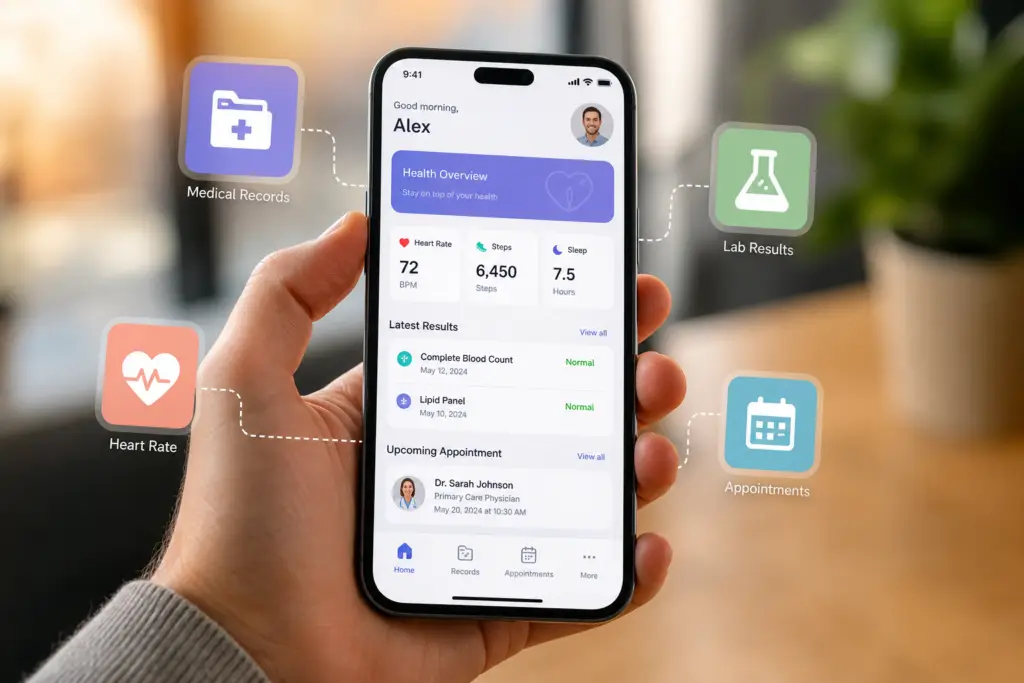
Managing your health information has never been simple. Between hospital visits, specialist appointments, lab results, and insurance paperwork, most people’s medical records are scattered across a dozen different systems — and getting a complete picture of your own health can feel like solving a puzzle with missing pieces. Google is now taking aim at that problem with the launch of Google Health, a new platform designed to bring all of your personal health data together in one place, while keeping you firmly in control of who sees it and how it is used.
What Is Google Health and Why Does It Matter?
Google Health is a centralized digital health platform that pulls together personal medical information from multiple sources — think doctors’ offices, hospitals, clinics, labs, and insurance providers — and organizes everything into a single, accessible location. For the average person juggling care from multiple providers, this kind of consolidation could be genuinely transformative.
The fragmentation of healthcare data has long been one of the biggest frustrations in modern medicine. Patients often have to manually request records, carry physical copies to new providers, or simply rely on memory when recounting their medical history. A unified platform that handles this automatically addresses a real and persistent gap in how people manage their health day to day.
Your Data, Your Rules
One of the most emphasized aspects of the new platform is user control. Google is positioning this not just as a convenience tool, but as a privacy-respecting service where individuals — not algorithms or advertisers — decide what happens with their health information. The phrase the company uses, “on your terms,” is not just a tagline. It signals a design philosophy built around granular permissions and personal agency.
This matters enormously in the health space, where trust is everything. Medical data is among the most sensitive personal information anyone holds, and there has historically been significant public skepticism about large tech companies entering the healthcare arena. By front-loading privacy messaging and emphasizing user choice, Google appears to be directly addressing those concerns.
- Granular access controls: Users can manage who is allowed to view their health information, from family members to physicians.
- Data sharing on demand: Rather than information being shared automatically, users are expected to initiate or approve any sharing with providers or third parties.
- Transparency mechanisms: The platform is designed to give users visibility into how their data is being stored and used.
Solving the Fragmented Healthcare Data Problem
The core problem Google Health is trying to solve is one that has plagued both patients and providers for years. When someone visits a new specialist, there is often a frustrating back-and-forth to obtain records from previous providers. Emergency situations can be particularly dangerous when a treating physician lacks access to a patient’s medication history, allergies, or prior diagnoses.
A centralized platform that aggregates this information could dramatically improve the quality and speed of care. Imagine walking into an urgent care visit and being able to instantly share a complete, up-to-date medical profile — including immunization records, chronic conditions, and current prescriptions — with a single tap. That kind of streamlined information exchange is exactly what platforms like Google Health aspire to enable.
For people managing chronic illnesses or navigating complex care across multiple specialists, the benefits could be even more significant. Coordinating between a cardiologist, an endocrinologist, a primary care physician, and a pharmacist becomes far more manageable when all relevant data lives in one accessible place.
Google’s Growing Presence in Digital Health
This announcement is not Google’s first move into the health technology space. The company has been steadily expanding its healthcare footprint over the past several years, investing in areas like medical imaging AI, health data interoperability, and wearable health tracking through its Fitbit acquisition. Google Health represents a consolidation of that broader strategy — a consumer-facing hub that ties together the company’s various health-related capabilities.
The timing is also significant. Digital health adoption has accelerated rapidly, particularly following the pandemic, which pushed both patients and providers toward telehealth and digital record management at an unprecedented pace. Consumer expectations around health technology have shifted dramatically, and there is now a genuine market appetite for tools that simplify health data management.
At the same time, Google faces real competition in this space. Apple has made significant strides with its Health app and health records integration on iPhone. Microsoft has its own healthcare cloud initiatives. Startups and established healthcare IT companies are also vying for a piece of the personal health management market. Google’s scale and ecosystem advantages could be significant differentiators, but winning user trust will be just as important as winning on features.
What This Means for Patients and Providers
For patients, the most immediate benefit is convenience and empowerment. Having a comprehensive, organized view of your own health history is something that has traditionally required significant effort to maintain manually. A platform that does this automatically — and keeps it updated — removes a meaningful burden from individuals who are already dealing with the stress of managing their health.
For healthcare providers, the potential benefits depend heavily on how widely the platform is adopted and how smoothly it integrates with existing electronic health record systems. If patients begin showing up with consolidated, shareable health profiles, it could meaningfully reduce administrative friction and help providers make better-informed decisions more quickly.
- Faster onboarding for new patients at clinics and hospitals
- Reduced risk of medication errors due to incomplete history
- Better care coordination across multi-provider treatment plans
- Greater patient engagement in managing their own health outcomes
Looking Ahead
Google Health is entering a space where the stakes — both for individual users and for the broader healthcare system — are exceptionally high. Done well, a platform like this has the potential to meaningfully improve how millions of people interact with their own health data and with the providers who care for them. Done poorly, or with insufficient attention to privacy and security, it could erode trust in both Google and digital health tools more broadly.
The emphasis on user control is a promising sign. Health data is deeply personal, and any platform that hopes to earn lasting adoption needs to treat it accordingly. As Google Health rolls out further details and features, the questions of data security, interoperability with existing healthcare systems, and real-world usability will all come into sharper focus.
For now, the direction is clear: Google wants to be your health data headquarters — and it is betting that giving you the keys to that hub will be the thing that makes you trust it enough to use it.