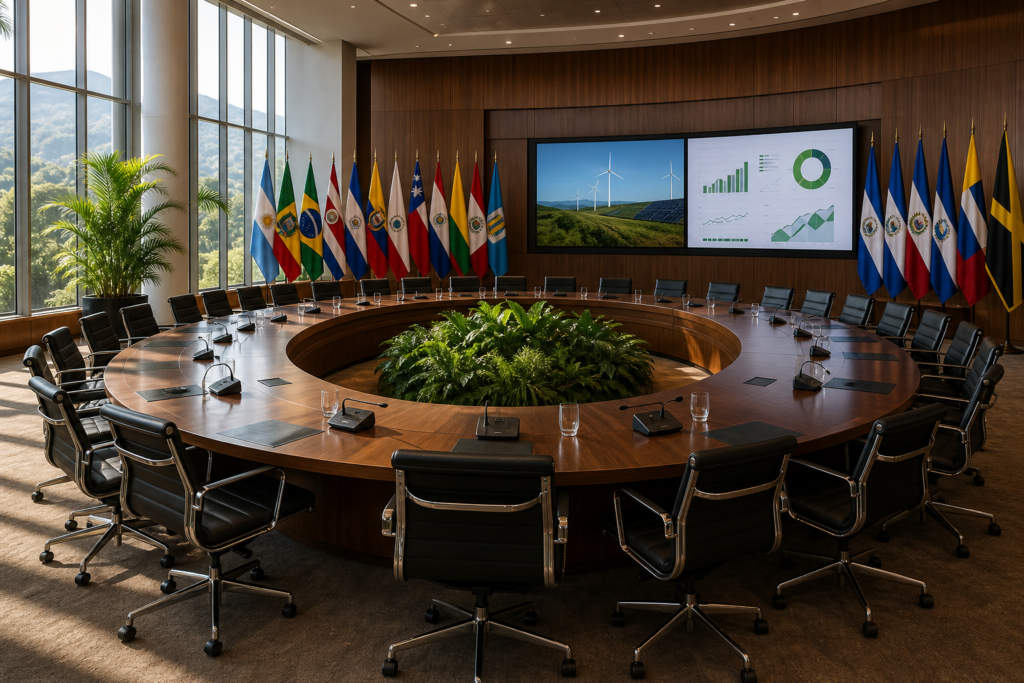
When people think about climate change, they often picture environmental agencies and conservation groups leading the charge. But increasingly, the real action is happening in a very different room — the finance ministry. Across Latin America and the Caribbean, a bold regional initiative is bringing together economy and finance ministers to do something that has rarely been done at scale: make climate policy a core pillar of economic strategy.
This is the story of the LAC Regional Climate Change Platform of Economy and Finance Ministries, a coordinated effort backed by the Inter-American Development Bank (IDB) that is quietly reshaping how governments in the region think about money, development, and the climate crisis.
Why Finance Ministries Matter for Climate Action
For decades, climate change was treated as an environmental problem — something handled by environment ministries, international conventions, and scientific panels. But as the costs of inaction have grown clearer, a new consensus has emerged: climate change is fundamentally an economic problem too.
Extreme weather events disrupt supply chains, destroy infrastructure, and devastate agricultural output. Rising sea levels threaten coastal cities and tourism-dependent economies. Droughts strain water resources critical for both agriculture and energy production. In Latin America and the Caribbean — a region extraordinarily rich in biodiversity yet highly vulnerable to climate shocks — these risks are not distant projections. They are present-day realities.
This is precisely why getting finance and economy ministries into the conversation is so critical. These are the institutions that control national budgets, set fiscal policy, manage debt, and negotiate with international lenders. Without their buy-in, even the best climate strategies struggle to find funding or long-term policy commitment.
What the LAC Climate Finance Platform Actually Does
The Inter-American Development Bank’s regional platform functions as a coordination mechanism — a structured space where senior economic and finance officials from across Latin America and the Caribbean can share knowledge, align strategies, and collectively push for stronger climate finance frameworks.
Several key functions define the platform’s work:
- Policy Alignment: Helping member countries align their national fiscal and economic policies with climate commitments, including their Nationally Determined Contributions (NDCs) under the Paris Agreement.
- Green Finance Development: Supporting the creation and expansion of green bonds, sustainable finance instruments, and climate-linked budget mechanisms that direct capital toward low-carbon and climate-resilient projects.
- Carbon Pricing Dialogue: Facilitating conversations around carbon pricing mechanisms — including carbon taxes and emissions trading schemes — that can generate domestic revenue while incentivizing emissions reductions.
- Climate Risk Integration: Encouraging governments to incorporate climate risk assessments into their broader fiscal planning and public investment frameworks.
- Resource Allocation: Helping nations — particularly smaller and more vulnerable economies in the Caribbean — access and efficiently deploy international climate finance, including funds from multilateral institutions and climate-focused global mechanisms.
The IDB’s Role as a Catalyst
The Inter-American Development Bank is not merely an observer in this process. As one of the primary multilateral development banks serving the LAC region, the IDB plays a hands-on role in both financing climate-related projects and building the institutional capacity of member governments to manage those investments effectively.
The IDB has made climate change a central pillar of its own lending strategy in recent years, committing to align its portfolio with the Paris Agreement goals and increasing the share of its financing directed toward climate adaptation and mitigation. By convening the regional platform, the IDB creates a feedback loop — one where the policy lessons learned by finance ministries inform how the bank structures its financing, and where IDB expertise and resources help governments build stronger domestic climate finance systems.
This multilateral backing gives the platform real credibility and staying power. It is not simply a talking shop. It is connected to actual lending pipelines, technical assistance programs, and international climate finance networks that can translate policy dialogue into on-the-ground action.
Why This Matters for Economic Development Across the Region
Latin America and the Caribbean is a region of stark contrasts. It includes major emerging economies like Brazil, Mexico, Colombia, and Argentina — countries with sophisticated financial systems and significant industrial bases — alongside small island developing states in the Caribbean that are among the most climate-vulnerable places on Earth, often contributing minimally to global emissions while bearing disproportionate consequences.
A coordinated regional approach to climate finance acknowledges this diversity while building collective strength. When finance ministers across the region speak with a more unified voice on issues like access to concessional climate finance, debt sustainability in the face of climate shocks, and the need for reformed international financial architecture, they carry significantly more weight in global negotiations than individual countries acting alone.
There is also a compelling economic development argument at play. The transition to a low-carbon economy represents one of the largest investment opportunities of the 21st century. Countries that build strong green finance frameworks early — developing the regulatory environments, financial instruments, and institutional expertise to attract sustainable investment — are better positioned to capture those opportunities. The LAC platform is, in part, about ensuring the region does not get left behind in this global transition.
Challenges That Still Need to Be Addressed
Despite the platform’s promise, significant challenges remain. Climate finance flows to developing regions continue to fall short of what is needed — a gap that has been acknowledged in successive international climate negotiations. Many LAC nations also face high levels of public debt, limiting the fiscal space available to fund ambitious climate investments without external support.
There is also the persistent challenge of translating high-level policy alignment into practical budget decisions at the national level. Embedding climate considerations into annual budget cycles, public procurement standards, and infrastructure planning requires sustained political will and significant institutional capacity — resources not all countries in the region possess equally.
Finally, carbon pricing remains a politically sensitive area in many countries, where concerns about economic competitiveness and the impact on lower-income households can slow adoption of what many economists consider one of the most effective climate policy tools available.
The Bigger Picture: Finance as a Climate Solution
The LAC Regional Climate Change Platform represents a broader global shift in how the climate crisis is being approached. Increasingly, the world’s financial institutions — from development banks to central banks to finance ministries — are recognizing that climate risk is financial risk, and that the tools of economic governance are essential instruments in addressing it.
For Latin America and the Caribbean, a region with so much at stake and so much potential, getting the financial architecture right is not just an environmental imperative. It is an economic survival strategy and a development opportunity rolled into one.
As this platform continues to evolve, it bears watching — not just by policymakers in the region, but by anyone interested in how the global economy will navigate one of the defining challenges of our era.