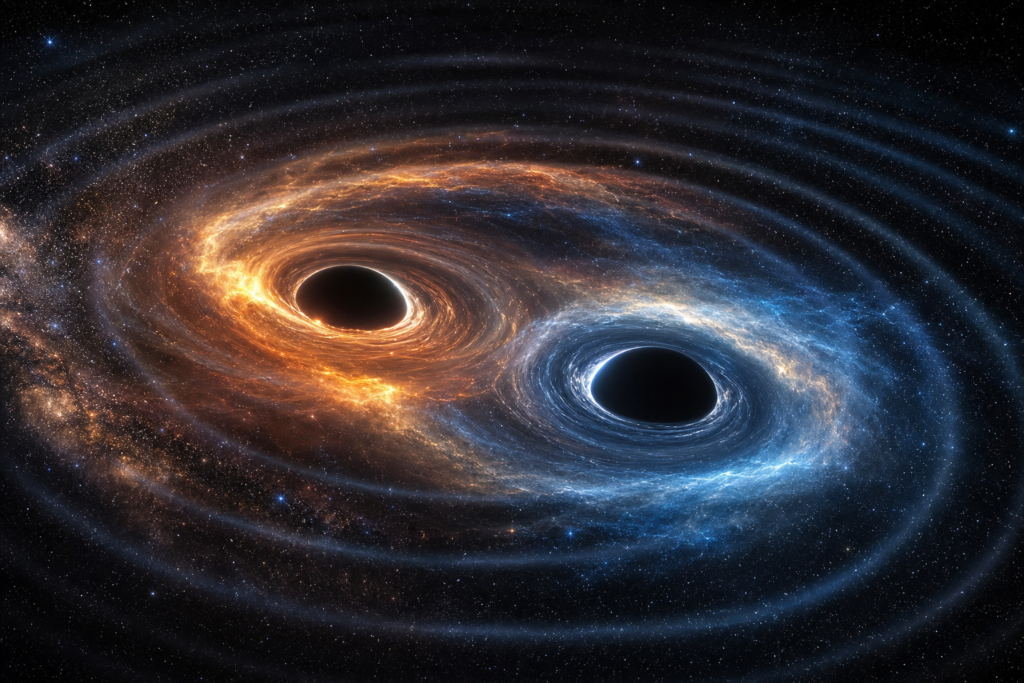
The universe’s most colossal black holes have a dark secret — and scientists are finally reading the evidence written directly into the fabric of spacetime. New research suggests that the largest black holes in existence did not grow through the quiet, conventional processes astronomers long assumed. Instead, their extraordinary size is the result of repeated, catastrophic collisions stretching back billions of years. The clues are hidden in gravitational waves, and researchers are just beginning to decode what those ripples are telling us.
The Old Theory Was Not Big Enough
For decades, astronomers had a working theory about how black holes form and grow. A massive star collapses at the end of its life, and over time, the resulting black hole gradually accumulates surrounding matter through a process called accretion — essentially feeding on nearby gas and dust. This model works reasonably well for explaining black holes of moderate size, but it runs into serious problems when scientists try to account for the truly enormous ones.
Ultramassive black holes — those with masses billions of times greater than our sun — have long presented a kind of cosmic mystery. Standard formation models simply could not explain how a black hole could pack on that much mass within the age of the universe. Something else had to be happening. Now, a growing body of evidence points to a far more dramatic answer.
Gravitational Waves Are Telling the Story
When two massive objects collide and merge, they send ripples through spacetime itself. These gravitational waves travel outward at the speed of light, carrying detailed information about the event that created them. Scientists at major gravitational wave detection facilities have spent years refining their ability to capture and interpret these signals, and the data is beginning to reveal something remarkable.
Researchers analyzing gravitational wave observations have found signatures suggesting that certain black holes carry a history of multiple merger events. Think of it like reading growth rings in a tree — each collision leaves a kind of imprint, and by studying the characteristics of gravitational wave signals carefully, scientists can piece together a timeline of cosmic violence that shaped the object in question.
This approach essentially allows astronomers to trace the biography of a black hole through the ripples it and its predecessors left behind in the universe’s fabric. It is a form of cosmic forensics unlike anything previously possible.
Mergers as the Engine of Extreme Growth
The central idea emerging from this research is that ultramassive black holes did not simply eat their way to enormous sizes — they grew through a chain of mergers. In this picture, black holes collide and combine, producing a larger black hole, which then merges with yet another, and so on across billions of years. Each collision adds mass and potentially alters the spin and other properties of the resulting object.
This merger-driven growth model solves several problems at once. It explains how black holes could achieve masses that would otherwise seem impossible under standard formation timelines. It also offers a reason why these monster black holes are found in specific cosmic environments, typically at the centers of large, ancient galaxies that have themselves grown through repeated mergers over their long histories.
There is also a connection to stellar physics here. Related research has examined something called the pair-instability mass gap — a theoretical range of masses where certain stars are expected to explode completely rather than leaving behind a compact remnant. Understanding how nuclear burning in massive stars influences what kinds of black holes can form in the first place is a critical context for interpreting the merger picture. The gravitational wave data help constrain these models in ways that were previously out of reach.
What This Means for Gravitational Wave Science
The implications of this research extend well beyond the question of how individual black holes formed. They touch on how astronomers should interpret the full catalog of gravitational wave observations being collected by facilities like LIGO and Virgo.
- Merger histories encoded in gravitational wave signals could become a standard tool for probing the formation pathways of compact objects across cosmic time.
- The findings suggest that some black holes detected through gravitational waves may themselves be the products of earlier mergers, meaning the objects we observe are already second or third generation.
- Refined theoretical models of pair-instability supernovae and stellar evolution will need to keep pace with observational data to give accurate interpretations of what is being detected.
- Understanding the population of ultramassive black holes has broader consequences for models of galaxy formation and evolution, since these objects sit at the hearts of galaxies and influence their surroundings profoundly.
In short, gravitational wave astronomy is maturing from a field focused on detecting signals to one capable of extracting detailed astrophysical histories from those signals. That is a significant leap.
Reading Violence Written Into Spacetime
There is something almost poetic about the idea that the most violent events in the universe leave permanent records in the structure of space and time. Every collision between black holes sends a message outward at the speed of light, a message that encodes the masses, spins, and orbital characteristics of the objects involved. Given enough sensitivity in our detectors and enough sophistication in our analysis, those messages become readable.
Scientists are now in the early stages of doing exactly that — translating the language of spacetime ripples into coherent accounts of black hole evolution. The picture that is emerging is one of a universe shaped far more by catastrophic events than by slow, quiet processes. The biggest black holes did not build themselves gently. They were forged in repeated moments of cosmic destruction, and the evidence has been traveling toward us ever since.
The Bigger Picture
This research arrives at a moment when gravitational wave astronomy is rapidly expanding its reach. New detector upgrades and future observatories promise even greater sensitivity, which means scientists will soon have access to gravitational wave signals from farther across the universe and from events involving a wider range of object masses. The ability to read merger histories from those signals could transform our understanding of how the universe built its largest structures.
For now, the key takeaway is clear: the monster black holes haunting the centers of galaxies have lived violent lives, and the proof is written into spacetime itself. What seemed like an unsolvable mystery about how such colossal objects could exist is giving way to an answer that is, in its own way, as dramatic as the events that produced these extraordinary objects in the first place.
Science is rarely more exciting than when a new window onto the universe opens — and gravitational wave astronomy is proving to be exactly that kind of window, revealing histories that were always there, waiting to be read.