Paper Mill Explosion Workers: What Happened in Longview, Washington
The paper mill explosion workers at Nippon Dynawave Packaging in Longview, Washington faced on the morning of May 27, 2026, is one of the most heartbreaking industrial tragedies I’ve followed in years — and I think it raises urgent questions every worker, employer, and insurer needs to hear. This wasn’t a slow-building crisis. It was a Tuesday morning, a regular shift, a routine day — and then everything changed. In this post, I’m going to walk you through exactly what happened, what it means for workers’ rights and insurance, and what you should know if you or someone you love works in a high-hazard industrial environment.
The Longview Paper Mill Explosion: Workers, Casualties, and a Community in Shock
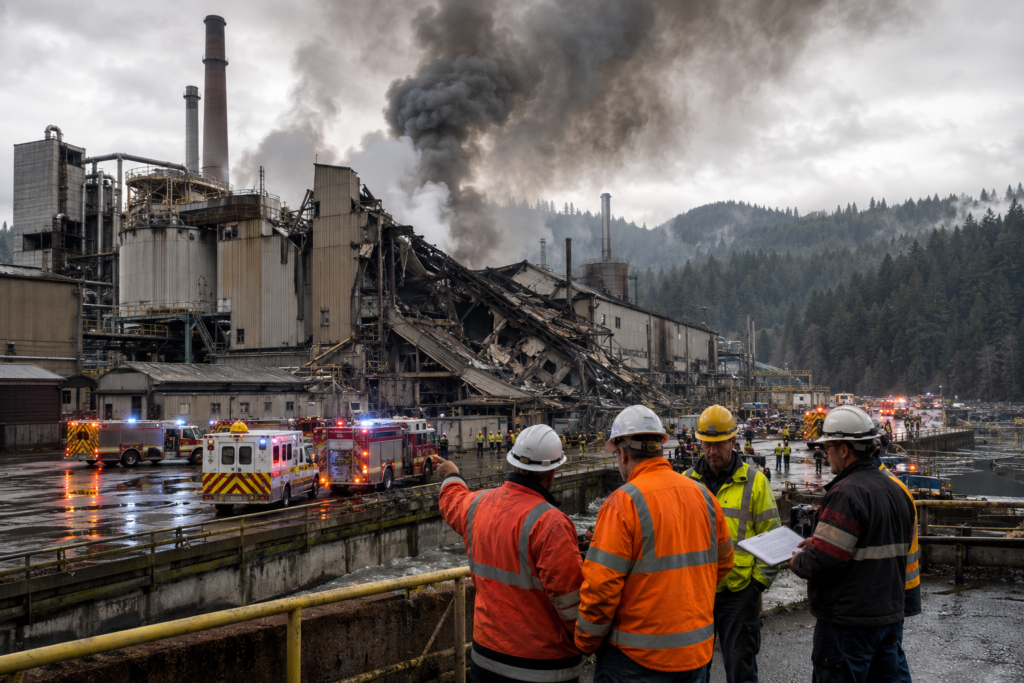
It started just after 7 a.m. A 900,000-gallon tank holding white liquor — a corrosive compound used in the paper-making process — ruptured at the Nippon Dynawave Packaging Company in Longview, Washington. The force of the rupture was so violent that officials struggled to even describe it. “Indeed, there was a rupture, a failure, a blast,” Cowlitz Fire and Rescue Chief Scott Goldstein said.
The toll was staggering. At least two people were killed and nine workers are “unrecovered” following the implosion of a chemical tank at the pulp and paper mill. Cowlitz County Fire Chief Scott Goldstein announced, “We have declared this incident a transition from rescue to recovery as of this morning.” That’s an official way of saying there is no longer any hope of finding survivors among the nine still missing.
Washington Governor Bob Ferguson didn’t mince words. “We’re bracing ourselves for this being the deadliest industrial tragedy in modern Washington state history. When you have a tragedy of that scale, the impact on individuals, on families and on communities is profound,” he said.
The recovery itself has been treacherous. The tank’s structural instability creates a dangerous situation for emergency responders, in part because it was estimated to still hold a potential 90,000 gallons of white liquor. The industrial disaster also resulted in contamination of the Columbia River, though officials said there is no danger to the Longview City water supply.
Among those confirmed dead is Gilbert Bernal, 52. His daughter described it as “an everyday, routine day.” His son Eli, who was working nearby, said there was a large cloud — “just that big steam cloud, it was everywhere. It was so vast, just like a cloud on the floor.” That detail — a cloud on the floor — haunts me. These were real people walking into what felt like any other morning.
The plant, which makes material for tissues, printing paper, cups, plates, cartons, and other goods, employs about 1,000 people according to the Washington State Department of Ecology. The U.S. Chemical Safety and Hazard Investigation Board announced a team of investigators will arrive at the site as it opens a formal investigation.
What Paper Mill Explosion Workers and Their Families Need to Know About Insurance and Legal Rights
When a disaster of this magnitude strikes, insurance and workers’ rights aren’t just bureaucratic fine print — they’re lifelines. So what should paper mill explosion workers and their families actually understand about their coverage options right now?
First, workers’ compensation is the immediate safety net. If you’re injured — or if you’re the family of someone killed — in a workplace incident, workers’ comp is typically the first claim to file. But here’s what a lot of people don’t realize: comp benefits are often just the floor, not the ceiling. Paper mill injuries can occur as a result of operator error, failure to properly inspect and maintain machinery, failure to implement OSHA standards, lack of proper safety gear, or defective products. When negligence is a factor, additional legal avenues may be open.
The Longview disaster is a vivid reminder of how significant those additional claims can be. Consider what happened in a comparable case: a jury awarded $104 million to nine survivors of the deadly 2017 explosion at a DeRidder paper mill, where three contract workers were killed and several others were injured. The plaintiffs brought claims of gross negligence, alleging failures in inspection, medical care, safety, emergency response, and training at the facility.
The industry’s safety record also matters here. According to the most recently available data from the Bureau of Labor Statistics, in 2024 there were 2.5 recordable injury cases per 100 full-time equivalent workers at U.S. pulp, paper, and paperboard mills — slightly above the national average of 2.3. There were six fatalities in the category in 2024, up from four in 2023. Those numbers feel abstract until a tragedy like Longview puts human faces on every data point.
If you’re a family member of one of the missing or injured, document everything. Keep records of medical treatment, communications from the employer, and any statements from officials. You’ll need to tell your employer of the incident to protect your right to workers’ compensation, and you should consider talking to an attorney — particularly if you were seriously injured or are having any problems with your workers’ comp claim. Don’t wait and don’t assume the company will handle things fairly on its own.
What to Watch Out For: Common Insurance Mistakes After Industrial Accidents
Industrial disasters create chaos — and in that chaos, families often make costly mistakes with their insurance and legal claims. Here’s what to avoid.
Don’t accept a quick settlement without legal review. In the immediate aftermath of a major accident, employers and insurers sometimes move fast to close claims before the full extent of injuries or liability is known. Claims are denied every day for missing information or incidents that employers claim are not work-related. You could be entitled to additional compensation by filing a personal injury lawsuit if someone other than your employer or a co-worker was responsible.
Don’t assume the employer has clean hands just because there’s no obvious prior record. The Nippon Dynawave Packaging site has a history of past environmental and safety violations, the Seattle Times reported. And yet the disaster still happened. Japan-based parent company Nippon Paper confirmed in a notice that a chemical tank at the facility collapsed, resulting in “multiple casualties,” and that the cause of the accident is currently under investigation. Investigation findings can dramatically change the scope of what insurance and legal claims look like.
Also, don’t overlook environmental exposure claims. Hazardous materials that paper mill workers can be exposed to include pesticides, chlorinated organic compounds, and other dangerous chemicals — and in a rupture involving white liquor at this scale, long-term health impacts on survivors and first responders could emerge over time. Make sure any insurance claim accounts for future medical monitoring and treatment, not just immediate injuries.
Final Word
The tragedy of paper mill explosion workers in Longview, Washington is still unfolding as I write this. Nine people remain unaccounted for. Families are waiting. A community is grieving. And investigators are just beginning to understand what went wrong inside that 900,000-gallon tank on an otherwise ordinary Tuesday morning.
If there’s one thing I want you to take away, it’s this: industrial workers deserve both safe conditions and a clear understanding of their rights when those conditions fail. Know what your workers’ compensation covers. Know when negligence opens the door to further legal action. Keep records from day one. And if you have a loved one in a high-hazard industry, talk to them — and to an attorney familiar with industrial accident claims — before something goes wrong.
The people of Longview showed up to a vigil holding photographs of their missing loved ones. The least the rest of us can do is make sure tragedies like this lead to better protections, better accountability, and families that are never left without answers or support. Stay informed, stay prepared, and look out for each other.